Monday, December 8, 2008

A classic piece of Chinese political philosophy & my interpretation


In one of our early classes, we had a lot of discussion about the relationship between a leader and his followers.I was then reminded of a well-accepted notion in Chinese political philosophy, which says: The relationship between a leader and his people is comparable to that between boat and water: water can contain a boat, and it can also capsize a boat. Derived fromA Proposal to the Emperor:Ten Notions,this boat-and-water notion dated back to Tang dynasty(618–907). It was authored by a senior government official named WEI Zheng, who was renowned for his righteousness and straightforwardness. As suggested by the title, WEI Zheng was appealing to the then emperor,LI Shi-min, pointing out ten things LI should keep in mind in order to make the state prosperous and stable.WEI's suggestions were well-received by LI, who kept the essay on his desk as a motto.

I first encountered this piece in my classic Chinese literature class as a freshman in high school.Impressed by its literary merit,I learned the whole piece by heart, which is no more than 450-Chinese characters-long,succinct and pertinent.However, only after our leadership theory class did i come to recognize the essay for its merits in addressing important aspects of leadership. Here i'd like to share with you this thought-provoking piece of literature. I hope you'll enjoy it as much as i do.(I spent a good amount of time translating it into English. Hopefully my translation can preserve its original strength in argumentation:)


A Proposal to the Emperor—Ten Notions

To make a tree grow better, one must reinforce its root; to make a river flow farther, one must clear its source; to make a state stable and prosperous, one must found it on virtue and morality. You don’t grow a tree by cutting off its root, nor do you vitalize a stream by blocking its spring. That’s common sense. By the same token, dwelling in peace and prosperity, Your Majesty should nonetheless be prepared for potential hard times and exercise economy. Otherwise, it would be impossible to build an empire as stable as prosperous.

Previous dynasties have witnessed the rise and fall of scores of emperors. Although many of them did reign with conscience and morality at the beginning, few could stick to the end. Why did they fail? I guess it’s because: in case of plight, a leader often treats his followers wholeheartedly, sparing no effort to consolidate them and mobilize them. However, once the difficulty is overcome and the common cause is realized, the leader is tempted to indulge in the hard-won success with a larger ego. Sincerity and sensibility can unite conflicting parties, while egocentricity and indifference attenuate bonds as strong as that between father and son. Sometimes a leader can get his way by overawing or coercing his followers. However, this will only encourage shrewd followers, who act to shun punishment rather than act out of conscience. A leader can never trade coercion for cohesion: all he harvests is superficial support,let alone respect. The relationship between a leader and his people is comparable to that between boat and water: water can contain a boat, and it can also capsize a boat. This is one thing leaders should always bear in mind.
Here I have “ten thoughts” to propose:

(1) Whenever you find an object desirable to possess, you should remind yourself of complacency instead of pursuing it straightaway.
(2) Before mobilizing extensive manpower to construct new palaces, think about moderation and necessity. People need peace, so try not to bother them too much.
(3) Aloft in position, Your Majesty is susceptible to aloofness. So always bear in mind the idea of humbleness and modesty, and never stop self-development.
(4) To avoid self-conceit and egocentricity, remember that the formation of a broad river is the joint effort of numerous brooks and streams.
(5) If you want to go hunting, go no more than three times a year.
(6) To prevent from slack attitudes, you should attend to a task with uniform diligence from beginning to end.
(7) To avoid being under-informed, you should be open to criticism and advice from your subordinates.
(8) If you fear that some ill-willed flatterers and immoral forces may erode the establishment, being a moral role model yourself will help to get rid of them.
(9, 10) When you award or punish people, don’t entitle to them more than what they deserve. Don’t simply award a person for pleasing you or punish one for annoying you.

If you can exercise these ten notions and glorify the Nine Virtues (loyalty, trustworthiness, respect, firmness, flexibility, harmony, stability, righteousness, and obedience), then good results will follow. Recruit the able ones into your cabinet, fit each into the right position and follow the wise advice. In this way, the smart will capitalize on their talent, the brave stretch every muscle, the kind-hearted spread their kindness and the loyal exercise fidelity. By delegating to the right persons, Your Majesty would reign effectively and effortlessly!


My interpretation:

The landscape in which an ancient emperor reigned is very different from what most organizational leaders face in a modern democracy.However, different social contexts see something in common in effective leaders.Some of WEI Zheng's theories are still applicable to today's leadership.In A Proposal to the Emperor:Ten Notions, WEI highlighted the moralities of leadership. Believing morality to be the cornerstone of a state,he advocated that an emperor must in the first place be a moral role model for his people, demonstrating virtues and justice.A leader should not coerce his followers by any means.Intimadation and suppression may work for some time, but it will not do in a long run.Not only because it's not a productive way to run an organization, it will eventually undermine the leadership.In case of an empire, people may uprise and overthrow the throne,in the same way water capsizes a boat. Here i see an objection to Theory X.

The second important thing a leader does is to delegate. Instead of attending to every triviality, a leader should delegate tasks to the right persons. This requires the leader to have a deep understanding of human nature, as well as expertise in certain fields.For the emperor,he needed to be familiar with military affairs, public administration and economics.

Some background information:

Tang dynasty (618–907) marked one of the most prosperous times in Chinese history. It succeeded the short-lived Sui dynasty and developed a successful form of government and administration on the Sui model. Besides military prowess and national wealth, Tang also stimulated a cultural and artistic flowering that amounted to a golden age. The creative vigor of Tang let it be a more open society, welcoming foreigners in its urban life from Japan, Korea, and Vietnam, as well as from Persia and West Asia.
The second emperor of Tang, LI Shi-min, known as T'ai-tsung, succeeded to the throne in 626 by murdering two brothers and forcing the abdication of his father, but he became one of the greatest emperors China has known. WEI Cheng was one of LI Shi-min’s Confucian moralist mentors. He had served a rival rebel regime, and later took on the role as Li Shi-min’s public conscience (John King Fairbank, 1992 & Encyclopedia Britannica, 2009).

Friday, December 5, 2008

Obama's "Third Culture Administration"

In a previous email, Dr. Robbins noted that Obama stated he hoped to avoid groupthink within his administration.

According to Ruth E. VanReken, members of the future Obama administration "[share] common psychological traits that could shape his administration" (http://www.thedailybeast.com/blogs-and-stories/2008-11-26/obamas-third-culture-team/). What VanReken is referring to is Obama's developmental background as a "third culture kid," an increasingly common background among children and adults in our increasingly multicultural and global society.

As a "third culture kid" myself, I am particularly interested to see how the diversity and relatability of some of these appointed leaders' experiences will shape new policies, and how their experiences might shape their leadership ability.

Wal-Mart: Culture and Cheer

Our class discussion about organizational culture sparked my own memory of my experiences at Wal-Mart, where I worked in Arkansas as a high school student. While I believe Wal-Mart is by no means a perfect organization and has many faults, the culture I experienced while working at Wal-Mart played a large role in developing a positive mental image of Wal-Mart while I worked there as an employee. The following is an analysis of Wal-Mart’s core values that underlie its culture.

In 1962, Sam Walton opened the very first Wal-Mart in Rogers, Arkansas. As the founder of this one-store organization, he established the company culture upon three basic beliefs: (1) respect for the individual, (2) service to our customers, and (3) striving for excellence. Today, almost half a century and many stores later, the values and organizational cultural which Walton valued still resonate among many of the over 2 million Wal-Mart associates throughout the world (
www.walmartstores.com).

(1) Respect for the Individual. At Wal-Mart, each employee is referred to as an “associate.” This verbalization emphasizes the shared ownership of Wal-Mart each associate has as an employee. This ownership is both a figurative metaphor which serves to open up lines of communication by downplaying the hierarchy between employees and managers, but is also literal, as many employees buy small shares of Wal-Mart stock, which is encouraged in the initial hire orientation.
(2) Service to Our Customers. At Wal-Mart service and servant leadership are key themes. According to Sam Walton, “Effective leaders don’t lead from behind a desk. It's more important than ever that we develop leaders who are servants, who listen to their partners – their associates – in a way that creates wonderful morale to help the whole team accomplish an overall goal” (www.walmartstores.com). Store managers and district managers are often seen on the floor making themselves available to all associates and practicing the “10-foot rule,” which encourages associates to each customer with the infamous, “How may I help you?” which is written on the back of every associates blue vest.
(3) Striving for Excellence. Wal-Mart employees are constantly encouraged to strive for excellence through competition and improvement. Three store-wide weekly meetings (for each of the three work-shifts) are held at which store managers, department managers, and associates discuss sales strategies (merchandise displays, cleanliness, friendliness), sales performance (compared daily, weekly, and one year earlier), and sales competition (among departments within the same store and with other stores regionally and nationally).
These three core values are particularly strongly embedded within the organization and each associate in part by a rigorous orientation which occurs after initial hiring. Before stepping foot on the actual store floor and beginning training, each associate watches a series of videos regarding Sam Walton’s life, core values, and history of the company. By watching these videos, many associates may become inspired. In many ways, the life of Sam Walton encompasses the American Dream of going from rags to riches. By working at Wal-Mart, they to have chance at the American Dream through hard work, promotions, and developing community relationships.
Perhaps one can best show the strength of Wal-Mart culture in the activities which often occur during the store-wide weekly meetings previously noted. These meetings are characterized by an open and inclusive family dinner table-like environment. Managers and associates come together in an open space in the back of the store to discuss store happenings, compare sales performances, share a package of cookies, and announce weekly birthdays of associates throughout the store. Each meeting ends with the infamous “Wal-Mart Cheer”:
Give me a W!
Give me an A!
Give me an L!
Give me a squiggly!
Give me an M!
Give me an A!
Give me an R!
Give me a T!
What's that spell?
Wal-Mart!
Whose Wal-Mart is it?
It's my Wal-Mart!
Who's number one?
The customer! Always!

To me, this cheer exemplifies Sam Walton’s original values of respect, service, and excellence which are still embodied and valued by many Wal-Mart managers and associates, regardless of the negative attention the corporate side of Wal-Mart has increasingly (and often deservedly) received in recent years.

Just For Fun:
Video of the Wal-Mart Cheer:
http://www.youtube.com/watch?v=3Ko94pzlLJs&feature=related

Innovation and creativity, anyone? Here is an example of some Wal-Mart employees in Sherwood, Arkansas, really taking “ownership” of the Wal-Mart Cheer and making it their own:
http://www.youtube.com/watch?v=aWSYzFtdhSA

Wednesday, December 3, 2008

Escape from Jonestown

A few weeks ago CNN aired a special about the Jonestown Massacre and particularly focused on the survivors of this event. The documentary immediately engaged my focus as I recalled some of our class readings and discussions especially echoing Milgrim’s article on obedience as well as the Groupthink article. The question that seems to spring from horrific incidents like this one is how could this possibly have happened? The theories that seem to shed some light on a possible answer to this question lie in these aforementioned articles. But before I continue, the following is a brief summary of the Jonestown Massacre for those who aren’t as familiar:

In 1978, 909 Americans died in Jonestown, an area established in South America by the Reverend Jim Jones, from an apparent mass murder-suicide by poison commanded by the reverend himself. One third of those that died that day were children, most of who were poisoned by their own parents. Only 33 people survived the ordeal. Besides September 11, this incident has been the greatest single day, non-natural disaster loss of American lives.

What struck me while watching the documentary was - what was it about those who lived that enabled them to survive? The answer is likely found in the results of Milgrim’s experiments. Just as Milgrim sought to answer what possessed the Nazi’s to carry out the horrific acts of the holocaust by conducting his experiment, so too might the answer for Jonestown be found.
The results of the experiment and the outcome of Jonestown are contrary to what most would expect and hope to occur. Most people would think that when moral values and obedience to authority conflict that people would choose to follow their morality rather than submit to an authority that breaks with these morals, but sadly this does not appear to be the case. Instead, many people feel psychologically compelled to submit both because they defer responsibility for their actions to the authority and also to avoid the stress associated with disobeying. In Jonestown, this appears to be exactly what happened. The negatives associated with dissenting felt greater than the negatives of submitting to these people and the strength of this feeling swelled to the great level that it was, because of the grip Groupthink had on them.
Groupthink is cultivated in part by the notion of the dilemma of obedience and it became a behavioral tool that Jim Jones used horrifically well. Symptoms of Groupthink, especially in this situation, are paranoia and fear; from the outset, Jim Jones attracted people whose personalities alone made them more susceptible to become victimized by Groupthink. He appealed to the ‘wounded’ side of people who shared a disillusioned view of society because many of them were outcasts and he made them feel that he related and understood their plight. He also had a message that seemed to lift them from their troubles. Yet, Jones grounded this message in fear and in doing so, created a culture of followers that were steadfastly loyal and unquestioning of his mission. To further create an environment of followers that sought to avoid disobedient behavior, Jones began a procedure known as catharsis in which any member who had committed a wrong doing or had been disagreeable was publicly humiliated and punished in front of the entire congregation. This reinforcing mechanism, witnessed in real life by his followers, served to elevate Groupthink, and particularly the ‘obedience factor’, to a tremendously dangerous level. No one wanted to disagree or be known by others as having differing thoughts.
Eventually people became trapped in the thick blanket of Groupthink, yet they didn’t really recognize it. The phenomenon grew so powerful that Jones was able to plant the seed of his mass suicide idea without receiving direct criticism and without causing his followers to discuss their disagreements behind his back. If anyone disagreed, they kept it to themselves and followed along with how everyone else reacted. In November of 1978, when his command came, all but 33 individuals became victims of Groupthink and the obedience dilemma. In the documentary, the commentator describes the incredible courage and strength it took for those 33 to survive by dissenting, which to an outsider looking in would seem like an ironic characterization - why would it take great strength to disagree with someone who is asking you to commit suicide? Yet, when one delves deeper into the psychological components at play here, the dismaying events of this day and why they occurred reveal the extreme courage that these individuals displayed to emerge from the guise that Jim Jones had created.

Sunday, November 30, 2008

What the Big 3 can learn from LPO 3450

We are all aware of the economic situation in the United States at this point. Every time I check CNN.com, the 6 o’clock news, or get a text message from my friends who are worried about choosing to major in Economics, there are talks about another bailout to a financial firm, industry, etc. The Big 3 (GM, Ford, and Chrysler) have requested $25 billion in government loans to cover costs due to the worst U.S. auto sales downturn in 25 years. However, Congress has abandoned a vote on the bailout because the CEOs have failed to produce clear plans on how they will change the way they do business. The CEOs will make another trip to Washington with detailed plans on how they will use the money to save the industry. These CEOs would benefit from a crash course on what we have learned in LPO 3450. Although, it is not practical to learn or become a leader based on the frameworks overnight, it would help to guide their decisions with respect to changing the structure and practices of the auto industry.

With respect to the state of the economy, which ultimately affects consumer decisions, the vision of the company must adapt to the changing external environment. Americans are finally starting to avoid purchasing automobiles with inefficient gas mileage. The days of buying a gas-guzzling, 12 mile per gallon SUV are long gone. Although gas prices are back down to around $2 per gallon, it is hard for Americans to forget last summer when prices were at least $4 per gallon. So the question remains, why are the Big 3 not producing cars that Americans want? In order to meet the needs of consumers, which will inevitably affect the bottom line or profit, the vision must change to reflect consumer demands. Nadler and Tushman would describe the current state of the Big 3 as in need of a re-creation, which is described as a risky endeavor initiated under crisis conditions and under sharp time constraints. It is important to note that most re-creations involve a change in the vision, core values, and structure of the organization. The key challenge for executives facing turbulent environments is to learn how to effectively initiate, lead, and manage re-creations.

In addition to changes in the vision, the abilities of charismatic leadership will facilitate the change or re-creation of the industry. Charismatic leadership is characterized by a clear collective vision and the ability to communicate it effectively to all employees. Similar to Choi’s definition of the components of charismatic leadership (envisioning, empathy, and empowerment), Nadler and Tushman use similar words to describe the same components: envision, energize, and enable. In order for the employees of the auto industry to implement the vision, the leaders must be able to energize and enable their employees to carry out practices that align with the adapted vision or re-creation of the industry.

However, visionary and charismatic leadership alone are not sufficient to re-create the industry. The auto industry must embody the characteristics of the learning organization (Senge) and the knowledge creating organization (Nonaka). Senge states “the impulse to learn, at its heart, is an impulse to be generative, expanding our capability.” He explains further that the learning organization must focus on generative learning, which is about creating, and adaptive learning, which is about coping. The culture of the auto industry has been more reactive than it has been proactive. In an industry, in which survival is dependent on having a competitive edge, generative learning is critical. This way the industry will focus on proactively generating new innovations as opposed to producing or creating as a response to increasing competition. Another important characteristic of the learning organization is leading though creative tension instead of problem solving. Senge explains that creative tension is the gap between current reality and the desirable future state. Leading through creative tension, organizations are motivated by accomplishing the vision. However, problem solving focuses on rectifying the problems and the motivation is based solely on the desire to escape the current undesirable state. The auto industry must avoid problem solving and begin to lead through creative tension, thereby constantly remaining ahead in the competition.

The reactive culture of the auto industry is a result of fear of failure. Risky decisions are avoided, which in turn prevents the development of new innovations. The industry tries to avoid the mistakes that can lead to innovative successes. This makes it difficult to make the shift from a play-it-safe corporate culture to an innovation-driven culture, which is an imperative to thrive in a globally competitive market. Nonaka uses specific words such as redundancy, metaphors, spiral of knowledge, etc to describe aspects of the knowledge creating company. These words are likely to be unpopular among CEOs and senior leadership of the Big 3. However, Nonaka explains that these aspects of the company that involve risk taking are characteristic of “the best Japanese companies that have the ability to respond quickly to customers, create new markets, rapidly develop new products, and dominate emergent technologies.” The Big 3 CEOs must understand that fear of failure and mistakes is an obstacle. However, this does not suggest that failure should be embraced to the point of losing profit. The failure to produce a plan on how the Big 3 will change business practices is a clear example of fear to change and take risks. Risk-taking will be necessary to develop new innovations, change practices, and restructure the industry.

It is clear that the CEOs of the Big 3 have a very complex situation at hand. However, there is no one solution, no “cookie cutter” approach that can be applied to the auto industry. Therefore, it is critical to focus on a holistic approach, which entails drawing from various leadership frameworks. Understanding the importance of the key points from each leadership framework can shape the new and/or reformed business practices of the Big 3. A clear plan, which incorporates the points addressed above as well as others, may prove to be more appealing to Congress.

Wednesday, November 26, 2008

Wait, I totally wanted to revisit the talk about the leader as "designer"

I wanted to comment on the discussion we had a couple of weeks ago about the leader as a designer because I think that this analysis has some implications that are important to review and critique.

The leader as “a designer” (as the name implies) is responsible for the “design” (duh) of the organization- but what I wonder is, what does this look like? We talked in the beginning of the semester about vision and the responsibility / opportunity of the follower to not only step in but alter / personalize this vision and I wonder if the “leader as a designer” allows for this—how does a leader balance follower / employee input while maintaining ownership and responsibility of the design? And furthermore, once a leader shares his design with others, who takes responsibility for the direction of the company?

I think that this last question is where I became particularly intrigued in our discussion in class relating to our current financial crisis… in a system where there are multiple organizations / leaders / factors at play, who takes responsibility?

For Heifitz, responsibility for an organization’s success and failure lies with both the leader and the community. But what if the communities, as Kelly categorizes them, are comprised of sheep (Heifitz, “Values of Leadership)? What if they choose / do not have the opportunity to be anything other than “passive and uncritical, lacking in initiative and sense of responsibility” [due to education and knowledge limitations, sense [or actual] of powerlessness etc.] (Kelly, In Praise of Followers, 195). Do we hold them responsible for being sheep and thus criticize them for not taking responsibility of the success and failures of the community / organization of which they are a part (by choice or circumstance)? Or do we agree with Burns, who says that success is a function of contribution to change, pressured by purpose drawn from collective motives and values (Burns, “Toward a General Theory”)? But again, who is the collective? And does the leader, as designer, also become responsible for adopting systematic, structural and procedural change? If he / she directs this change, how can he / she share the responsibility for the outcome with the collective? The collective, as participants, carry out the tasks / responsibilities necessary to implement the change, but if the leader is the designer, how, if, when, by whom the change is implemented is solely his / her responsibility- or is it? If we assume that the collective is comprised of (again as Kelly calls them) “effective followers” because they think critically, are self-managers, and are not afraid (and do!) challenge the leadership… if they do not simply complete the tasks / assignments they are given without thinking critically about the consequences and previous decisions made to lead to their change in role / responsibility (aka are not “sheep”) then maybe we also hold them responsible—but again, this is contingent upon the fact that these followers are “effective followers”— and that is dependent upon the leader’s ability to pick those types of followers…
But how does he / she do that?

Can we, using the most common recruiting techniques, determine which people to pick?- can we tell from interviews, essays and most basically resumes, who will be “effective followers”—I think we determined in class that no, these methods are inefficient—so what do we do instead?

One tactic that I know we mentioned in class, but did not develop to the fullest potential in my opinion is the idea of ‘trail periods’- why does our evaluation of the quality of an employee end with the last interview stage? An organization hires an employee after a candidate completes the application process and is deemed suitable for the position- but what if we put “hires” in quotations and allow for a trial period to determine, from actual work experience with the organization, if the organization’s initial impression was in fact correct and that the new “hire” is not only suitable but excels in the position. So what difference do the quotations make?- The potential new employee is accepted into the organization and completes tasks that require minimal training (I should have prefaced that this particular idea is adapted to deal with entry level positions but could certainly be altered to accommodate upper-level placements). The organization’s leaders / peer level position occupants etc. can observe and evaluate the new hires work habits, ethic and moral foundation, creativity, potential (aka their ability to be “effective followers”) etc. during the trial period—and while benefiting from the work completed by the new “hire” (and paying them for their services) they can also evaluate whether or not they want to hire the employee (without the quotations). Thus, after a two month period (aka long enough to be able to observe the “hire” but not so long that the organization looses on the opportunity for the “hire” to truly contribute to the organization’s processes as a fulltime employee) the organization / designer decides whether or not to train and integrate the employee and officially hire him / her. I should say that this plan is certainly not flawless (and with this brief description even I have left out some critical components) but the intention is the most important: allowing an opportunity for creative hiring practices gives organizations the potential to hire “effective followers” that will benefit the organization and actively take responsibility / ownership for the organization’s successes and failures.

The point? An attempt to answer my initial question… what does a “designer” look like?
Do they:

Create a vision
With the help of others? Adapted by others? Allow others to take ownership of the vision? Do they respect a diversity of views within the community? Should they?

Design strategy to advance the goals of the organization (as they align with the vision)
Develop norms and a group culture
Orchestrate conflict
Compromise?
Make viable decisions that affect the organization’s vision
Exhibit choice and priority making
Does this include negotiation?
Organize human effort
Especially related to the ability to control and predict behavior and consequences of decisions
(Ideas adopted from Heifitz, Burns and Stogdill)
AND, can there be more than one?
Do we run into the same problems we have when we have “too many cooks in the kitchen?” I say, not if we turn to McGregor’s principle that “leadership is not a property of the individual, but a complex relationship among these variables” [on contingency theory of leadership] (McGregor, “An Analysis of Leadership”) “Designers” = Leaders, must be willing to allow others to influence their original designs and, at times, share their kitchen with “effective followers”.

Wait. I lied. I like this idea better.

Not designers. Contractors.
I am abandoning the designer metaphor. Leaders are contractors. Their vision for an “initial build” or even “remodel” must depend on the ideas, specialties, creativity, needs, of all other stakeholders [vision building]. Once the vision is created, the contractor must rely on other “effective followers” to be successful- the architect, plumber, electrician etc.- leaders who specialize in a particular department- all necessary to accomplishing the vision – the contractor hires, based on a trial period- if the “roofer” isn’t displaying the necessary characteristics up to the contractor’s standards, he / she will be replaced – the contractor designs a strategy to advance the goals / components of the vision, develops norms and a group culture, orchestrates conflict, makes viable decisions that affect the vision, exhibit choice and priority making, and organize human effort… all with the input and contributions of his / her “effective followers”. And if he / she is successful? It was because of the collective. And if he / she fails? It was because of the collective. But in either case, it is his/ her responsibility. He / she caries that gift, or burden, as a leader- in other words, it may not be his / her fault, but as leaders, they are entrusted with the “build” / “remodel” and it’s their responsibility to, to the best of their ability, ensure effective and efficient success.

Monday, November 24, 2008

Leadership Nominating Committee

Leadership Nominating Committee
Were we looking for the right qualities and experience?

Watch out y’all! An inside look into sororities…

A little background:

As an active member of Pi Beta Phi (Pi Phi), one is expected to serve in at least one position throughout the three and a half years. There are over 50 positions in the house ranging from extremely active such as the executive board, to the intramural sports chair. I had a few positions throughout my time; however the most important position I had was the co-chair of the Leadership and Nominating Committee (LNC). This committee, made up of two girls from each of the sophomore, junior, and senior classes, is the only committee appointed by the President. All other positions in Pi Phi are applied for and consist of an application stating skills and experience, as well as an interview process. The purpose of LNC is to read every application, interview, and place the Pi Phis into their appropriate positions. This process becomes somewhat of a puzzle with over 50 positions and over 120 girls in the house and takes up to a few weeks to complete.

Now onto the class relevance:
Essentially, LNC chooses leaders from a group of applicants who must continue to uphold Pi Phi values and steer the sorority in the right direction. We, as committee members, looked specifically for experience and leadership qualities. We wanted to make sure that the applicant was responsible, sociable, dependable, and was able to make good judgments. They should have had experience in the field they were applying for, for example: a girl applying for the philanthropy position should have had experience with community service, etc. Also, the girls should have been able to work well with the others in their cohorts horizontally and vertically (this is where the puzzle comes in). LNC members who serve on the committee their junior year typically become co-chairs of LNC their senior year and learn from experience. One thing we learned from previous years was that those applicants who work well together develop a good rapport and are better equipped at motivating the other Pi Phis in the house to join in on their activities.

After examining the readings from this class, I have come to find that our idea of leadership in LNC was a combination of born vs. made. We believed that both trait theory and experience played a part in the leaders we chose to run our organization. There were many of Stogdill’s characteristics often written on our sheets as possible adjectives to use while we discussed applicants. But like McGregor, we made sure to understand that experience could make up for a lack of traits, and that “skills and attitudes…can be acquired by people who differ widely in their inborn traits and abilities”. We also believed, like Selznick that leadership was an active process and would have to take place within the relationship of the leaders and followers, therefore it was important to make sure that the applicants would get along. Another aspect of leadership that we worked on was the adaptability of applicants in their specific positions. We made sure that the applicants would get along with the other girls well and be able to adapt to difficult situations. As Rost has explained, “the only possible way for people to cope with such multiple relationships is for them to be leaders in some relationships and followers in others”.

Through reliving my experiences on LNC, I have found that not only were we pretty accurate at choosing leaders, but we ourselves were leaders! We were the designers of the sorority. “Leadership in learning organizations centers on subtler and ultimately more important work” (Senge, 1990). We were chosen for good reason by our President (most of us had some sort of leadership position before and were studying psychology in some fashion), and were able to put it to good use. Since we were appointed to the position and had ample chances to deny, we all had the intrinsic motivation necessary to carry out our position as creators of the new face of Pi Phi. We all brought unique qualities and experiences to the table and were able to work well with each other deliberating decisions for hours. The only limitation I could see in our leadership style is Janis’ idea of groupthink. Due to our long hours considering many applicants for many positions, at the end of the day we may have all wanted to agree and remained loyal to the group instead of voicing a differing opinion.

Thank you for reading up on Pi Phi and have a great Thanksgiving break!

Wednesday, November 19, 2008

Outliers

Just something of interest to those who want to enjoy some reading over the holidays. This seemed right up our alley with some of our class discussions, particularly after watching the video on extraordinary individuals. 

http://www.time.com/time/magazine/article/0,9171,1858880-1,00.html

Application of Leadership Theories to the Military

I just read an article on msnbc.com titled, Admirals, generals: Let gays serve openly, that discussed the possibility of repealing a military policy concerning sexual orientation, simply put “don’t ask, don’t tell.” This article gives a glimpse of the cultural structure contained in the military, an occupation that many people, including my parents, choose to become a part of. Because I am the product of the military lifestyle, it seemed only right to discuss the potential theories of leadership within this federal organization, where I had the opportunity to watch my mother advance to levels that were unheard of for the majority of females at the time. The military has to have leaders that execute leadership, but how are leaders chosen in order to assume the position?
The process begins in recruitment where each candidate is required to pass an aptitude test in order to know what occupation within the military he or she would be best qualified to be trained in. The aptitude test may highlight some of the natural abilities and strengths the person will bring to the military. Boot camp consists of requiring everyone to look the same, stripping away individuality, in hopes of instilling the value of being a part of a team. More importantly, boot camp seeks to get recruits to become adept to following orders, no matter how illogical some may seem in the training. As Robert E. Kelley stated, “We are convinced that corporations succeed or fail, compete or crumble, on the basis of how well they are led” (Kelley, 1988). Because the military can find themselves in very dangerous and high stress level situations, such as war for example, it is imperative that the soldiers under command are able to follow and execute orders that are, in some instances, a matter of life or death.
The military has an “up or out” policy that requires members to actively seek to improve themselves while in the service or face the possibility of being fired. There are certain benchmarks in place or certain ranks that men and women are supposed to achieve by a specified amount of time. In order to obtain promotions, training is provided to the candidates. For some ranks, candidates must have completed a certain level of training before consideration. However, because the military is like a pyramid, where advancement becomes more competitive and fewer are promoted at each level, it is not solely training that get candidates promoted, it is also there ability to implement the skills learned into practice within their respective field that shows they are able to take the training and utilize it when necessary efficiently. Opportunities are provided for candidates to execute their knowledge through application and because of the structure of the military, there is some supervision, and because of that, there are also opportunities for personal conferences for feedback purposes (Tead, 1935).
As stated before, very few members of the military make it to the top, so what is it about them that sets them apart from the rest? There are some traits that are highly important in this line of work and others that vary and can be utilized when needed. From observation, leaders in this organization display a high level of loyalty and trust, which is important in a field where one knowingly acknowledges the possibility of giving up one’s life for the safety of his or her country. Ralph Stogdill classified some leadership traits into broader general headings, ones in which are essential to the military: capacity, achievement, responsibility, participation, and status (Stogdill, 1948). Of course, Stogdill also mentions that the leader’s ability varies depending on the “characteristics, activities, and goals of the followers” and is situational (Stogdill, 1948). The military members assigned to leadership positions should be a role model to their followers. Leading by example assists with establishing respect and trust with the followers. Building on the relationship between leader and follower creates referent power, where both exert influence over one another (Hughes, 1993).
There are many theories that assist with describing what a leader is and what leadership consists of. Unfortunately, I only had a chance to discuss a few theories that describe leadership through the context of the military. While many may join the military initially, only a select few make it to the top. It is through the experiences that they have and the innate personal skills and talents they bring to any given situation that propels them to positions of leadership.

Monday, November 10, 2008

Why we need to develop leaders

Happy Monday everyone! I know we did not have too much time to discuss the readings from the past couple of weeks on creativity and leaders as teachers, so I just wanted to share some of my thoughts. Regardless of the theory a company uses, creativity and teaching are essential for success. Unfortunately, the United States is currently feeling the lingering effects of a leadership crisis stemming from the post-World War II era and the incredible economic success which allowed the country to have a sense of complacency. Meanwhile, other countries around the world were struggling to develop new strategies for overtaking the hegemon that the United States became.
I recently read Jay Conger and Beth Benjamin’s book, Building Leaders: How Successful Companies Develop the Next Generation (1999), in which they discuss how after World War II, many industries in the United States’ have operated under the theory that “if it’s not broken, don’t fix it” and consequently allowed leaders to maintain the status quo and not worry about thinking creatively to grow their organizations. Certainly some corporations have served as the exception, but overall, the majority of the United States did not see the need for leadership development when everything was going so well. It appears that many companies took Philip Selznick’s concept of leadership seriously when he asserts that “leadership is not equally necessary in all large-scale organizations, or in any one at all times” (Selznick, 1957). Notice that his writing was printed in the 1950’s, the same time in American history when this theory seemed to resonate with people. Many people in our class seemed to disagree with this assertion, but many companies chose to believe that during their successful years, “visionary leadership” was not necessary.
In regards to the idea of leaders as teachers, it is interesting to note that this idea first appeared in the 1930’s as America was desperately searching for leadership in the recovery from the Great Depression, and now appears again in recent times as America seeks to reclaim its dominant role in the international arena. The readings on leadership as creativity and innovation also come from the past decade and highlight Japanese companies as today’s most prolific innovators. It is certainly relieving to see that America realizes its blunder and with all of the leadership development emphasis that is occurring in the corporate world, is actively trying to remedy the problem.
Nearly all of the researchers mention setting a vision as one of the key tasks of a leader, and this is especially true in creative leadership. There is nothing creative about maintaining the status quo. Creativity needs to be nurtured and protected as shown in Richard Florida and Jim Goodnight’s description of SAS, as well Beer, Khurana, and Weber’s study of Hewlett-Packard. Something that has become apparent throughout all of the different themes is the inter-connectedness of these leadership components. Creativity is promoted through culture, and culture is determined by the vision the leader sets for the company. The vision and culture can only flourish if the followers allow them to, and that no one vision is well-suited for every situation, as is clearly demonstrated by Carly Fiorina. However, very few if any people can see all of this without some sort of training or leadership helping to reveal it to them. The importance of the leaders as teachers in helping to develop others enables the future leaders to understand this more fully.

Sunday, November 9, 2008

David Palmer for President

Presidents are leaders, by status and as seen by their followership. They are Commander in Chief of the United States of America and are appointed for the people and by the people. However, all presidents have their own leadership styles. I will use this post to argue that the fictional television character of David Palmer on 24 is an ideal example of a President’s leadership style. I will also analyze Barack Obama’s leadership style in context of David Palmer’s.

In class we discussed the presidential candidate’s leadership qualities, and I believe that David Palmer is a combination of the candidate’s positive qualities and more. Even on this fictional television show, David Palmer represents a history maker as the first African American President. He is straightforward and truthful, always stating what he believes while being reasonable to actions that need to be taken. He understands what people want and need, and is thoughtful, wise, and fair. David Palmer is incredibly ethical and treats others with respect. He is a problem solver, and when he cannot solve a task by himself, he calls on his loyal followers to help. He is humble, but assertive when necessary, and is considerate of other people’s beliefs.

David Palmer’s leadership style is situational. He is able to act accordingly to different issues. He is a transformational leader in the sense that his followers see him as a regular citizen and can therefore identify with him. He mobilizes his people by example, showing them that ethics, morals, and values can be utilized during times of crisis (which happen quite often on 24), and that persistence and consistency can lead the country through these times of crisis. However, even though his morals and ideals remain the same, he is changing and transforming the ideals of others to follow his lead. Burns would say that this is the route to an aspirational goal: change and transformational work by the people.

David Palmer is also a very charismatic leader. Choi would describe the leadership style as a “motivational theory of charismatic leadership…(suggesting) that a charismatic leader generally generates positive individual and organizational outcomes by displaying behaviors that stimulate followers’ needs.” (Choi, 2006) This ideal form of Presidential leadership is to some extent echoed by Barack Obama. Many have referred to him as a charismatic leader. Our class described him as a history maker, transformational leader, mobilizer, servant leader, and creator and protector of his core values: hope, change and unity.

Barack Obama’s 30 minute “Obama Vision” commercial is a great example of his leadership style being very similar to that of David Palmer. The personal stories about middle class Americans illustrated his care for the people as well as showed the viewers how his specific policies would give those families the solutions they needed. He discussed how the country is enduring some challenging times, however we have had even tougher times before and that we will prevail. He spoke of a better future for every American in a new era of responsibility and discussed how in order to get America back on track we need to concentrate on Middle America and not the fortune 500 companies. His optimism and uniting terms show the viewers that this is “Our home” and empowers us to come together to fight for our causes. He said, “There is no liberal America, there is no conservative America… there is the United States of America”.

This charismatic speech is something similar to what David Palmer would say when addressing the nation, making sure to identify with the people, empower them to feel as though they can be a part of making decisions for their country. In Barack Obama’s case, he was able to do this with his nomination to become President of the United States of America. His followers feel as though they contributed to making history. Now, we as a country must wait to see if Barack Obama’s leadership style remains steadfast and consistent and if he follows the ideal path that David Palmer has paved in his fictional television show.

Who knows, maybe one day we’ll be yelling, “David Palmer for President!”

Wednesday, November 5, 2008

Higher Ed Learning in Accreditation

The Scope of Leadership in Election 2008

In light of this historic moment in America, I was moved by the reaction of my friends abroad. In addition to the text messages, phone calls, emails, facebook messages from my family and friends in America, I received two international phone calls from a friend in Trinidad and a friend in Ethiopia. I received emails from my former students in Ethiopia, emails from two friends in Argentina, another from a friend in Brazil, as well as several facebook messages from my former Ethiopian co-workers (when I was an ESL teacher in Addis Ababa, Ethiopia). The reactions from my international friends were those of shock, happiness, excitement, etc. For example, my former student wrote “Wow, America has a president that looks like me. That is very good” and my former co-worker wrote “Congratulations to your country! They elected a black president I am happy for you guys. I thought that could never happen in a place like America. It gives hope to people in my country who suffer from discrimination because of their ethnic group. Maybe an Oromo will become president of Ethiopia in years to come. Change came to America and will come to other countries too.”

Thinking back to our discussion about the leadership of the candidates, I began to think about Obama’s transformational leadership abilities. Obama was able to address the needs of followers while elevating these followers to a higher moral level. Evident from his speech last night, it was and is a joint pursuit of shared goals and aspirations for change. However, the scope of Obama’s leadership extends beyond America and into the lives of the global community. He is able to evoke the spirit of hope, change, and unity not just for Americans but for citizens of the world. Just look at this clip showing global Obama celebrations: http://www.cnn.com/video/?/video/bestoftv/2008/11/05/mxp.obama.worldwide.cnn

As I sat in a few tears, shock, excitement and every other emotion felt when history is made, I was proud of Obama’s and the Democratic Party’s exceptional campaign and victory. But more important, I was very proud of America. This historic moment not only demonstrated the leadership of the Democratic Party but also that of the American citizen, who participated in democratic process regardless of their party affiliation, personal beliefs, or candidate choice. This election truly manifested the leadership abilities of American citizens. Everyone who casted a vote (whether for Mc Cain, Obama, or other) displayed exceptional leadership by taking a stand for the future of this country. It is important to note the world is proud of America! We were and hopefully will continue to be small l leaders in changing the future of this country!!

Wednesday, October 29, 2008

Some Comments on a Time Article

I’ve been reading Time magazine since October. It came to my attention that, up to now, four out of five cover stories are dedicated to the presidential election and one to financial crisis. This is quite understandable, since both issues hold center stage in our life today. What’s more, their interplay is as subtle as significant.
In Does Temperament Matter? (Time, Oct 27, p40), a well-written and easy reading piece of work, Nancy Gibbs addresses both issues with crispy wits. Besides analyzing the distinctive ways Obama and McCain react to the ongoing financial crisis, she tries to measure the weight temperament can have on presidential leadership in a historical perspective.

In short, I find this article to be a conversational account of traits theories-also a hybrid one.

Under the subtitle of What Qualities Matter, Gibbs discusses a number of traits which are conducive to successful leadership. Here I’ll just comment on some of her arguments.

1. Intelligence vs Willingness to Hear Different Voices
Only the brightest ones among us can be capable leaders? Is that true? “It’s good to be smart, but that’s no guarantee of success; Woodrow Wilson, the only President with a Ph.D., never won over a majority of voters. More important is the confidence that lets you welcome smart people around you – and hope they disagree.” A good leader should make his/herself open to different opinions. True willingness to hear various and even conflicting voices is different from surface tolerance. Think of this: after making a proposal, a leader asks his people for their opinion. When they speak up, he/she just pretends to be listening. Then he/she ends up with his/her pre-determined plan and calls it the fruit of group discussion. This is not a rare case. It’s frustrating for followers to find out that the leader is not really interested in what they are saying. Don’t try to fool them. They can always tell. So when you listen, listen completely. The ability to accommodate conflicting ideas lies in one’s self-confidence and a larger concern with corporate goal beyond self-interests. Gibbs uses Lincoln’s story as a showcase. When people asked Lincoln why he stocked his Cabinet with former adversaries, Lincoln said, “Look, these are the strongest and most able men in the country. The country’s in peril. I need them by my side.”

2. Vitality & Resilience
“Perhaps even more important than intelligence is vitality: Tiger beats Eeyore any day.” Before set out envisioning and mobilizing followers, a leader needs to be self-motivated. He needs the energy to take actions and the resources to put ideas into practice. “Resilience helps too; every President will get thrown back against a wall and need to come back stronger. Just ask Bill Clinton. So do steadfastness, persistence, conviction.” So far Gibbs has given us a pretty good list of essential traits. If she stops at this point, it’s fine. However, she goes on saying that, “But as soon as you make the list, it mocks you, for history is a dance of luck and intent, and sometimes they trip each other.” This actually takes her argument to the next level as it touches upon situational theories.

3. Situational Theories
Again, Gibbs illustrates her point by giving examples. Wilson was strong enough to win a war but too stubborn to save the peace, while Hoover never understood that politics was more art than engineering. A question naturally arises from the above discussion is: Is leadership transferrable? Does a successful leader in one context automatically excel in another? Is their performance predictable? “Not only can’t you know what a President will face, but his reflexes in one crisis may not be typical of how he responds to another,” Gibbs observes. This echoes the situational theories we learned in class.

Obama and his Eloquence

Through out the campaign Barack Obama has been back-handedly complimented for his eloquence. According to his political opponents being a charismatic communicator is a strike against Obama in some way. If he speaks well, inspires millions in the U.S. and around the world, and garners the enthusiastic endorsements of artists and entertainers, it is not because he is a leader, but because he is a silver tongued celebrity. Though pundits debate whether it is a positive or negative attribute, most agree that Obama is a gifted communicator. I can't help but wonder how this a bad thing.

Hackman and Johnson define leadership specifically as "communication which modifies the attitudes and behaviors of others in order to meet group goals and needs" (Hackman and Johnson, 1991). In this conception it is communication that defines leadership. Leadership effectiveness depends on whether one can process cues from the environment, listen well to others, and establish satisfying group relationships. Leaders are those who can take this input from others and convert it into vision for the future. Obama matches these traits. As a person of mixed race in a predominantly white environment he is adept at understanding his situation and molding the impression he makes. He has established a reputation for inviting divergent views to the table in order to hear perspectives other than his own. He has inspired the most productive movement of professional and volunteer organizers, people who are satisfied just to be a part of the process. Most of all he has cast a large vision for the future in simple words like unity, hope and change.

Marshall Sashkin captures this idea in his conception of visionary leadership. A visionary leader is someone who can construct a vision and create an ideal image of the organization and its culture (Sashkin, 1989). This leader then must be able to define the organizational philosophy and put it into practice with programs and policies. An effective leader, according to Sashkin, is one who can express an organizational aim, through written and face to face relations, and extend this vision in a variety of circumstances. Obama is a quintessential visionary leader.

Communication and vision casting are not trivial traits. Look at the history of the United States and you will find that great presidents are known for exactly these skills. Lincoln stood up to the seceding South in the vision of the Emancipation Proclamation and the eloquence of his second inaugural address. Franklin D. Roosevelt calmed the fears of the nation in the Depression through fireside radio chats and called the country to defeat fascism in World War II through rousing rhetoric. John F. Kennedy was in office such a short time, but is remembered on behalf of his image management, his optimism, and his vision for the future. And Ronald Reagan, an actor, was hailed for his oratorical skills as he communicated his way through the end of the Cold War. That is what good presidents do. They listen to the public, and then speak for America. They invite confidence and participation. They use words and style to advocate on behalf of policy, both here and abroad. They embody the image of the nation. These are not small traits, rather they are quite charismatic.

To further substantiate this view of leaderhip as communication, we need only look at its antithesis: George Bush. I do not bring his presidency up as a straw man. Any honest citizen must acknowledge that President Bush has enacted some good programs, like the emergency fund for AIDS in Africa. But by all accounts he has not been a good communicator and this has cost the country in her own self confidence and reputation around the world. In the wake of this administration of little listening, miscast vision and poorly communicated plans, the nation needs a visionary leader, someone who can rebrand America both internally and externally, someone who can make people believe again. If eloquence is essential in that endeavor, then Obama should not be faulted for his fluency.

Saturday, October 25, 2008

Toyota's creative innovations

Reading the "The Knowledge-Creating Company," I was reminded of visiting Toyota Corporation in while studying abroad in Japan. I was particularly intrigued by the idea of using metaphors as a way to communicate implicit knowledge into explicit knowledge, and the use of teams to create competition and dialogue among various perspectives to invent the most innovative product.

Here are some links showing Toyota's most recent innovations which I thought that you might enjoy:
http://www.youtube.com/watch?v=CQmoTJFScMY
I was actually lucky enough to see this 'band' perform when I visited the corporation!
http://www.youtube.com/watch?v=Xs_vL9g4IYk&feature=related

As energy-efficiency becomes an important part of the economic and political dialogue in our country, I wonder what policies could be made on the government and local levels which could encourage corporations to incorporate knowledge-creating management styles within their organizations to pursue energy sustainability. I wonder if it would be more effective for our government or a company to pursue the creative innovations which would lead to a more sustainable future. The culture of a company is important in encouraging creative innovation. Does the type (state or corporation) also matter?

Presidential Leadership Debate?

So, I don't know whether we decided to have a discussion about the leadership styles of the presidential candidates this Wednesday or not. As I have been a super nerd about following the campaign, I thought that I would share some information that I found regarding what others are saying about Obama and McCain's leadership styles. I hope that this will help get the brain juices flowing for the discussion, if we decide to have it. :)

An article about a speech Obama made at Northwestern's graduation regarding his leadership lessons (this article is done in 3 parts, so you have to click on the link on the left if you want to read all 3 parts)
http://www.gather.com/viewArticle.jsp?articleId=281474976823779
Obama's leadership lessons outlined:
1. The world doesn't just revolve around you. Have empathy
2. Challenge yourself. Take some risks in your life.
3. Perseverance. Making a mark on this world is hard. It takes patience and perseverance, and failure is part of the job description. but you have to keep on plugging at it.

A comparison of Obama and McCain's leadership styles: http://www.latimes.com/news/politics/la-na-assess20-2008sep20,0,7459654.story

An analysis of the candidates' personality types according to Myers Brigg's personality test (there is also an analysis according to personality of Gore and Bush from 2004 linked on the same page, which i found interesting): http://www.slate.com/id/2184696/pagenum/all/

Wednesday, October 15, 2008

The torture and victory of the Shamanic Transformation

>Given that our conversation got kind of spiritual and philosophical tonight, I thought that I would share the following in relation to the servant leadership topic.

McGregor describes the quintessential leader as a “fully integrated human being”. Greenleaf (1977) describes servant leaders as “people who put other people’s need, aspiration, and interests above their own”. Yet does this paradigm of self-sacrifice characterize the fullness of the “fully integrated human being” model which McGregor prescribes?

Native Americans view leadership as a tribal phenomenon, in which the leader is the servant and guide of the community. Organizations of all types can be viewed in this light. The Native American role of “Shaman” fits the prophetic image of “co-creator” that Greenleaf describes. In the seminal and groundbreaking work, “Black Elk Speaks” John Neihardt recounts the story of one of the most powerful Shaman in human history, Black Elk. Black Elk was called upon by the Great Grandfather Spirit to use his gifts of miraculous faith healing and prophetic witness to lead his people through the horrific trials of the Battle of the Little Big Horn and the Wounded Knee Massacre. Black Elk’s story is neither singular nor categorically unique, as there was another Shaman, 2000 years prior who God anointed to shake the very foundations of Creation itself and usher in an era of love, power, soundness of mind, faith, hope, and solidarity for the human family.

Throughout human existence, not just famous Shaman like Mother Theresa, Gandhi, or Martin Luther King but unsung and untold warriors of faith from every religious and spiritual tradition have fought against the forces of darkness for the benefit of Mother Earth and human kind. Even in Block’s notion of the stewardship contract, we see the image of individuals who rule themselves and thus are capable of leading through following and following through leading.

Bearing all of this in mind, I posit the following as steps that in my view, all individuals must experience to become fully integrated as “leaders” or “Shaman” in the Native American conception. This is only my view, and is not to be seen as normative in any way shape or form. This is also more of a theological than scholarly viewpoint and should be viewed as such:

Step 1 entails an awareness of God and the other. The infantile state of woman or man is a state of love accentuated by pronounced self-centeredness and self preservation. Though no one would argue that infants are not full of love, the love of the infant is ultimately self-absorbed as they are relatively unaware of the suffering, beauty, and courageous integrity of the beings around them. So step 1 of the Shamanic Journey entails obtaining an awareness that one is not alone in the world and that both a Supreme Being of love and other beings of light exist.

Step 2 entails a commitment to serve this Supreme Being of love and other human and non-human beings of light. Pronounced feelings of joy and transcendence often surround submission to step 2 of the process as one relinquishes the strangling decadence of self-sufficiency and commits oneself to a higher purpose of service.

Step 3 however is a tortuous and grueling sojourn which few Shaman can fully master in this human life. Step 3 entails learning to love oneself in the midst of serving God and others. This step requires almost super-human levels of self-control, self-discipline, and diligence as one must learn to balance the seemingly counterbalancing imperatives to love and Serve God and others, yet still love, serve, protect, and defend oneself. However, as the diligent Shaman learns to master this step she or he begins to operate in a kind of open hand Karma Yoga in which he or she accepts the things that he or she cannot change while raging in courage to usher forth God’s light into the human experience. Many Shaman commit suicide or turn to self-destructive behaviors due to the unmitigated pain and suffering of this stage. However, given the infinite grace and mercy of the Divine, ALL SHAMAN do make it through this rite of passage, though many must finish the process in the afterlife.

Once the committed Shaman masters step 3, she or he, must then learn to literally Co-Create with God. This is often through communication and imagination, akin to the kind of envisioning and empowerment to which Choi (2004) alludes. As the prologue of John intimates those who receive God, are given power to become sons and daughters of God, or in other words, little Gods. Consequently, step 4 is a passage toward paradoxical dependence on and independence from God in which the Shaman is literally able to hold depending on God and creating the elements of God such as Joy, happiness, and holiness in tension. This stage can be even more challenging and tortuous than stage 3 because it is often characterized by pronounced rejection and isolation. For how can one learn to create love, when one is surrounded by love? Rather one must learn to create love in the midst of its absence or at least its opposite.

Step 5 is the moment of full human integration that characterizes the master Shaman. This is the moment in which the Shaman experiences the sublime reality of oneness with God and all living creatures. Jesus, as the greatest and most profound of all Shaman experienced this moment in his resurrection at which point he literally became the center or omega point of all creation.

As I converse with Shamanic individuals of all religious and spiritual traditions, I am touched by a kind of Cryos moment in which the “icy cold” winds of the Holy Spirit, the great spirit have created a existential crossroads for humanity. America’s flirting with electing an African-American president and the much needed wake up call of our societies current economic crisis, alert one to the reality that God is speaking to God’s Shaman. In reality, all human beings are called and predestined to become Shaman. So the question is not one of destiny but rather chronology, for some have the gift of being the “first born of many”. It is to these “first born” to whom God is speaking. God is calling the first born of all Shaman, to a kind of accelerated transformation in which the Shamanic process is no longer linear but rather cyclical and synergistically reinforcing. In other words, Shaman are finding themselves in steps 3 and 4 simultaneously or finding themselves regressing from step 3 to step 1, etc. etc. Similarly, dark forces are capitalizing on this flux and are attempting to totally obliterate both the nascent and seasoned Shaman alike.

So what are we to do? What is God telling us?

As discussed in class, the critical error of Shaman throughout history has been delusion of the Atlas Complex. The Atlas Complex stems from Shaman believing that they are alone in their journey, mandates, call, and obligations. This creates the delusion that they must single handedly bear the weight of the world on their shoulders. In reality only one Shaman, Jesus, was asked to this, and because he did it, it is no longer necessary for the rest of us. What God is telling the Shaman of this historic era, is “You cannot do it by yourself!!” “YOU MUST UNITE TO COMPLETE THE PROCESS”. The secret that God is now revealing is that no Shaman can complete steps 1 through 5 through their relationship with God alone, but it is only through solidarity with others of similar calling that they can reach full maturity. Consequently, it is time for us. Those who have been called to the higher calling of God’s Kingdom and the Justice, Mercy, and Faith that it entails to unite. We have not been called to unite against anything in particular, but rather for each other!! When we unite for one another then we will win this war not against flesh and blood but against the spirits of selfishness, ignorance, hatred, and oppression that afflict us all.

Thanks mucho,

Wood

Wednesday, October 8, 2008

Charisma & the Desire for Need Satisfaction

Leadership that inspires the movement of the masses is something that has always been highly intriguing to me. How is it that one person can motivate hundreds of thousands, even millions, of individuals, who in most cases they have never met personally, and inspire them to work towards a common goal? What is it about these leaders that enable them to do this? These massive movements, such as the Indian independence movement, Nazism, or the civil rights movements all had an epicenter of one individual- Gandhi, Hitler, and Dr. King respectively, but trickled out to thousands.

My thoughts on this subject were again brought to life this summer when I read Jon Krakauer's Under the Banner of Heaven and again, more recently, with the fury of interest that the American public displayed with the initial announcement of Sarah Palin as the VP nominee.

The former, Under the Banner of Heaven, is a story that revolves around a murder that took place in the 80's, but is really a historical account of the birth and rapid growth of the Church of Jesus Christ of Latter Day Saints (LDS), also known as Mormonism. Currently, Mormonism is the fastest spreading religious movement in the Western hemisphere with more that 11 million members, and is on track for becoming a major world religion (krakauer 3-4). How this movement came to be and continues to sprawl was the result of the initial action of one individual. The LDS church was founded in 1830 by Joseph Smith, a man, who it has been inferred, was the embodiment of a charismatic individual if there ever was one. "He [Joseph Smith]," Krakauer writes, "was imbued with that exceedingly rare magnetism - an extraordinary spiritual power that always seems to be wrapped in both great mystery and great danger" (Krakauer 112). A firsthand account described Smith as follows, "The zest for living that he radiated never failed to inspire his own people with a sense of the richness of life. They followed him slavishly and devotedly, if only to warm themselves in the glow of his presence" (krakauer 113).

These descriptions beg to question whether it truly is solely this charismatic essence that is responsible for these movements. Is charisma a requisite needed in order to rally a significant following such as this? Acting as a magnet, as Krakauer delineates, that attracts followers? I would argue that, as Choi does, charisma certainly plays a vital role in these occurrences, but it is not the only role that is at play here. Another element that propels these movements is the potential satisfaction of a human need(s) - (in some cases, this can actually be thought of as an extension of situational theory). Choi writes, "a charismatic leader generally generates positive individual and organizational outcomes by displaying behaviors that stimulate followers' needs" and I agree with this. In each of these situations there has been a human craving among many individuals, be it equal rights, or security, or the sense that life is being lived "right", that needs to be satisfied. Charismatic leadership, it seems, can be thus understood as a dynamic force whose fundamental backbone responsible for initiating social movement is the combination of a 'Charismatic Leader' plus 'A Purpose that Satisfies a Need'. I do not think that there are the only factors contributing to a movement's continuation, however. Various factors must occur in order to keep the momentum going- to highlight one: the role that followers play. Through their interactions with each other and outsiders, they have the ability to influence and increase the movement. By passing on "tales" of and interactions with their "great leader", followers have the ability to elevate their leaders to legendary status and in doing so attract more followers.

This is but one facet of the evolution of social movements, of which I don't have space to go further, but it is interesting to explore the core elements at play that allow these movements to get underway and sustain themselves.

Tuesday, October 7, 2008

Take the lead…


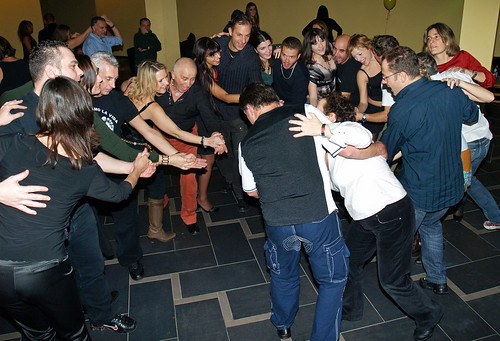
I am not thinking about the movie but about dance, especially salsa. I remember my dance teachers say that when you dance salsa in couples, the guy takes the lead and the girl has to follow him. And this is a common point among different salsa dance styles. And this idea somehow was not clear for me until I heard a Cuban teacher said that the guy would take the lead in order to make the girl shine bright. Furthermore, he is supposed to smile at her and make her feel great so that you will naturally respond to this “suggestion” smiling and will look charming. It sounds interesting for me: a good metaphor that illustrates how I understand leadership, a relationship of mutual influence that implies that he is not the leader and she is not a follower where dancers are part of an entity that achieves a specific goal, enjoying dancing salsa for instance. The fascinating thing is that when you see or dance salsa, you cannot be aware of this leadership; you are just enjoying the dance.

You can consider that this is not an adequate example, because it is based on a duo. But I can continue with another salsa style, “rueda de casino”. This is a dance performed in couples, have you ever seen it? 

Well, there are pairs that form a circle and dance and, when a caller/leader of the group makes a sign, they exchange partners without loosing the rhythm. And, any naïve spectator will not realize how they do it, you just know they are doing such a wonderful performance, with a precise coordination where the ability of individuals and the group is mise-en-scène! What is going on there? I believe that besides time to practice, to have such a performance, everybody knows his/her role (dance steps and times) as well as the caller assumes is one of them but also has a leader role and dancers trust their leader and the actions he/she will guide.

Maybe I am relating this situation with what I have seen in many organizations, where the minimal unit is a team, under the guidance of a manager who is supposed to be a leader, most of the times. You can observe, in the best performance teams, that they are doing a great job and you will only notice what happened when you ask the leader what she/he has done. I believe that there is more than team member’s mastery and commitment with his/her duties, and the acceptance of the legitimacy of the leader. I dare to say that mutual collaboration and trust on each other’s commitment makes these teams achieve their goals.

Monday, October 6, 2008

Another Look at "Social Responsibility"

Even before our discussion in class last week, I have been particularly interested in corporate social responsibility. Val brought it to my attention after class, that after one of my usual rants (the one that included Ben and Jerry’s… yes, I realize that there were many and I appreciate your patience with me) that I indicated that I was so moved by their talk at Vanderbilt last year that left the Student Center having a complete understanding “of what I want to do with my life”. It wasn’t until Val brought it up that I recognized that I never clarified what that was- and maybe it was in the interest of time, or out of a desire to not loose my train of thought. Either way, I think it is that interest that also propels this Blog entry, and so I apologize in advance if it sounds rather dramatic. And so to answer your question Val, I do not want to be a professional ice cream scooper or even better, taster, (although I agree with you that that would be fun!) but rather I am intrigued by Ben and Jerry’s attempts at incorporating “social responsibility” into their primary vision and I would love to pursue consulting with the intention of directing organizations about how to integrate (into their existing processes) “socially responsible” elements. That being said, I am sorry for the life story, here is where I think this fits in to our class work:

Although I recognize that Milton Friedman does have some valid points about the problem with compromising profits in the name of an “artificial responsibility” [considering that “only people can have responsibilities”] I believe that the two are not mutually exclusive. Aside from the Ben and Jerry’s example, couldn’t we imagine a situation in which it would be in the organization’s best interest (i.e. increased profits) to act socially responsible? Independent from the (still) mysterious Body Shop woman’s promise to donating 5% of her profits to charity, what if we followed Don Quijote’s example of an imaginative leader (aha! a good example of where this principle could be beneficial if controlled!) and found a way for ‘social responsibility’ to benefit both parties without risking profit.

To kick start this idea, lets imagine a small business, “X”, is interested in introducing a new candy bar. Their target consumer is between ages 15-18. Business “X”, before releasing their candy bar, wants to ensure that their target demographic understands what the candy bar is and why it is better than other candy bars on the market + wants to get them to by this candy bar = recognizes the necessity to conduct market research. In the past, organizations might employ an external marketing organization to conduct a research study, compile a focus group, compare their competitor’s strategies etc. Although these have been successful for many businesses, one limitation has been revealing avenues to directly communicate to the consumer. So here is where this idea of “social responsibility” could be integrated into business “X’s existing processes…who better to understand what the audience wants and needs than someone in that audience? Why couldn’t business “X” depend on a high school aged “Ivan intern” (at no cost to them) to disseminate information about the candy bar, educate business “X’s” marketing team about their audience, relate to the customer, and more adequately explain the value proposition of the product? Wouldn’t this give business “X” the marketing scope and audience understanding they need to be successful while also expanding their opportunities to directly reach their target audience? Doesn’t this also allow “Ivan intern” to put a highly valued career experience on his resume? And isn’t this benefit heightened if Ivan aspired to go to college but is from an under resourced school where extracurricular opportunities are limited? I recognize that there are limitations to this example, i.e. Ivan’s ability to perform these tasks effectively and the time taken to train him but couldn’t we really get somewhere with this?

Another example. What is stopping Fido’s (coffee shop on 21st; I highly recommend it) from hosting an event organized by Children’s Hospital volunteers to make slippers for patients? The Children’s Hospital uses Fido’s space (brings all of the necessary supplies) and benefits from Fido’s existing popularity and name recognition. Meanwhile Fido’s increases their profit (immediately because of the increased traffic flow through their store on the day of the event and after in establishing a new clientele base/support).

Another example. The Vanderbilt women’s lacrosse team decides to “adopt” an 11 year old girl with brain cancer. This adoption includes having Makenzie appear at games and sit on the sideline with the team, giving extra Vanderbilt gear to her and her younger brother, inviting her family to the end of the year celebration banquet etc. Makenzie benefits from the love and support the team offers her and her family (without doing anything extra but including her in what is already expected of the team) and the team finds some extra energy and motivation to appreciate the game, their teammates, and the health of their bodies… and, if they are lucky, like Northwestern (who has won four national championships since the year they “adopted” Jacklyn) they might find their love and care for another translates into success.

Regardless of the type of business or team, organizations have a collective power, (money, resources, support) to do what people cannot on their own. If, in agreement with the contingency theory, an organization is equally affected by the external environment as the situations, transactions, processes etc. that occur within, I argue that it is exceedingly important to cultivate abundant and healthy and relationships with external parties (i.e. the community). Rather than expect public service or “social responsibility” to consume profit, let’s explore ways that we can accomplish both: allow “corporate social responsibility” to penetrate existing processes and consequently if not increase profit, at least maintain what would be gained without integrating socially responsible ideals.

As long as we can find ways for organizations to minimize the “transaction cost” of integrating such “socially responsible” events into corporate processes I am confident that we could cultivate a new corporate culture- one that enhances the communities of which these businesses are a part without compromising profits. And who better to start these movements than the leaders of these organizations? I am not suggesting that this “vision” for transforming corporate America need be created and maintained solely by the leaders: that it is limited by “providing a vision and influencing others to realize it through non-coercive means” (Heifitz, 1994). Rather if our current short-comings in not taking advantage of businesses’ collective power is a problem (and I argue that it is), the solution should not come from leaders who exclusively influence “the community to follow their vision” but from those that “influence the community to face its problems” (Heifitz, 1994). This style of leadership would look more like Sashkin’s model (oh the “e”s = express, explain, extend, expand) with a modified “first step” (Sashkin, 1989). Without going into all of them, I suggest a “modified step” that (rather than encouraging others to be committed to “the leader’s vision”) requires a leader to “focus others’ attention on key issues [the lack of corporate social responsibility]- helping people grasp, understand and become committed” to the cause: thus depending on “effective followers” to collaboratively create a vision (Sashkin, 1989; Kelly, 1998). With this adjustment, I think Sashkin’s outline of effective leadership would be very valuable in this situation especially in that it allows followers to be “empowered” to affect real change. Change that does not separate from the bottom line, but embraces a socially responsible means to enhance it.

“Never doubt that a small group of thoughtful, committed people can change the world. Indeed, it is the only thing that ever has.”
Margaret Mead

Friday, October 3, 2008

Authoritative Style

Just a tidbit of a comment below.

The authoritative style of leadership is more dictatorial than its actual definition because it is derived from the word "authority."
Though "authoritative" denotes a negative style of leading, it
is a psychological term that describes different parenting styles. An authoritative parenting style should be discerned from the "authoritarian." I do not know whether the leadership term is derived from the psychological meaning, but it was the first thing I thought of when hearing of this in Goleman's work.

Authoritarian parents
are highly demanding and directive, but not responsive. "They are obedience- and status-oriented, and expect their orders to be obeyed without explanation" (Baumrind, 1991, p. 62). These parents provide well-ordered and structured environments with clearly stated rules. Authoritarian parents can be divided into two types: nonauthoritarian-directive, who are directive, but not intrusive or autocratic in their use of power, and authoritarian-directive, who are highly intrusive.

Authoritative parents are both demanding and responsive. "They monitor and impart clear standards for their children’s conduct. They are assertive, but not intrusive and restrictive. Their disciplinary methods are supportive, rather than punitive. They want their children to be assertive as well as socially responsible, and self-regulated as well as cooperative" (Baumrind, 1991, p. 62).


citation: http://www.athealth.com/Practitioner/ceduc/parentingstyles.html

Sunday, September 28, 2008

Milgram's Influence

There was a story on singer Dar Williams on NPR this morning; I was fascinated to hear her discuss her new song called "Buzzer" inspired by the Milgram experiments; you can listen to it here: http://www.npr.org/templates/story/story.php?storyId=95082381

Wednesday, September 24, 2008

Leadership Theory and Gang Persistence

A cautionary note anchors this discussion. This discussion in no way promotes or justifies the formation and/or survival of gangs and/or gang related activities.

After reading for class, I turned on the TV and began to watch a program called Gangland on the History channel. The program primarily focused on the origin and workings of the Bloods, a gang based in New York with smaller affiliations predominately in New Jersey and Baltimore. In addition, the program also focused on the key leader of the gang, Omar Portee aka O.G. Mack. Different explanations were offered for the persistence of gangs despite efforts by multiple facets of law enforcement to dismantle these organizations. It is evident that the leadership and structure of gangs are instrumental in explaining the persistence of not just the Bloods but also various gangs across the country. Several aspects of charismatic leadership as well as specific characteristics of followers may provide insight to the origins of gangs and answer the questions of how and why they survive.

Choi explains key aspects of charismatic leadership, in which the leader is effective in addressing the followers’ need for power, affiliation, and achievement. In 1993 in Rikers Island, one of New York City’s largest jail facilities, O.G. Mack created the United Blood Nation (UBN) as a way to protect African American inmates from the Latin Kings, which was the most prevalent gang in the jail system at the time. Based on Choi’s conclusions, O.G. Mack was able to capitalize on African American inmates’ need for power in relation to that of the Latin Kings, need for affiliation with a group of inmates who shared common views, and finally their need for achievement within the prison system. Another critical aspect of gang formation coincides with the notion that followers are committed to the organization and to a purpose or principle (Kelly, 1988). In this particular case, Blood members were committed to the ultimate purpose of the organization, which was to create and maintain a network of protection. Although that was the primary purpose of the gang, as members were paroled and returned to their communities, the purpose of the organization steered in the direction of personal and to a lesser extent communal economic achievement. With this new purpose, the new wave of gang members were drawn in due to the leaders’ ability to effectively satisfy the needs of members who felt alienated from society based on racial and/or socioeconomic status. For these gang members, their affiliation with the UBN provided a source of empowerment and fostered their personal ideals of achievement. In a sentence, several aspects of charismatic leadership with respect to gang leaders are apparent in the formation of gangs.

In light of the discussion above, law enforcement officials usually pay close attention to the leaders of gangs with the perception that eliminating the source will inevitably dismantle the entire organization. Despite these efforts, which usually result in the incarceration of gang leaders, gangs continue to persist. The conclusions about the leadership relationship between leaders and followers as proposed by Rost offer a possible explanation for gang survival. Rost argues that followers can become leaders and vice versa in any leadership relationship. He also argues that only people who are active in the leadership process are followers. Accordingly, gang members who are active in the leadership process, though not formally recognized as leaders, have the potential to become the next leader in the event of absent leadership. The fluidity of the leadership continuum exhibited in the structure of gangs allows for gang members to assume leadership, thus sustaining the organization. It is pertinent to note that as a result of this leadership continuum, the potential for gangs to become institutionalized is not unlikely. Therefore despite changes in leadership, gangs are able to survive for years and in some cases decades.

Considering the leadership and structure of gangs, they should be perceived as having an organizational hierarchy similar to that of corporate companies. Within this framework, gangs have both an established chain of command and interchangeable leader and follower positions. In an organization where leadership is not static and there is a leadership relationship with active and effective followers, eradicating such an organization may be more complicated. Therefore, it is a naïve line of reasoning that eliminating the leadership of gangs will dismantle the organization. Similarly, firing the CEO and Board of Trust, will not dismantle an entire company if there are followers that are effective in assuming leadership. As many studies on gang suppression suggest, it may prove more effective to focus on prevention and/or remediation programs that address prospective and current gang members’ need for power, affiliation, and achievement.