I’ve been reading Time magazine since October. It came to my attention that, up to now, four out of five cover stories are dedicated to the presidential election and one to financial crisis. This is quite understandable, since both issues hold center stage in our life today. What’s more, their interplay is as subtle as significant.
In Does Temperament Matter? (Time, Oct 27, p40), a well-written and easy reading piece of work, Nancy Gibbs addresses both issues with crispy wits. Besides analyzing the distinctive ways Obama and McCain react to the ongoing financial crisis, she tries to measure the weight temperament can have on presidential leadership in a historical perspective.
In short, I find this article to be a conversational account of traits theories-also a hybrid one.
Under the subtitle of What Qualities Matter, Gibbs discusses a number of traits which are conducive to successful leadership. Here I’ll just comment on some of her arguments.
1. Intelligence vs Willingness to Hear Different Voices
Only the brightest ones among us can be capable leaders? Is that true? “It’s good to be smart, but that’s no guarantee of success; Woodrow Wilson, the only President with a Ph.D., never won over a majority of voters. More important is the confidence that lets you welcome smart people around you – and hope they disagree.” A good leader should make his/herself open to different opinions. True willingness to hear various and even conflicting voices is different from surface tolerance. Think of this: after making a proposal, a leader asks his people for their opinion. When they speak up, he/she just pretends to be listening. Then he/she ends up with his/her pre-determined plan and calls it the fruit of group discussion. This is not a rare case. It’s frustrating for followers to find out that the leader is not really interested in what they are saying. Don’t try to fool them. They can always tell. So when you listen, listen completely. The ability to accommodate conflicting ideas lies in one’s self-confidence and a larger concern with corporate goal beyond self-interests. Gibbs uses Lincoln’s story as a showcase. When people asked Lincoln why he stocked his Cabinet with former adversaries, Lincoln said, “Look, these are the strongest and most able men in the country. The country’s in peril. I need them by my side.”
2. Vitality & Resilience
“Perhaps even more important than intelligence is vitality: Tiger beats Eeyore any day.” Before set out envisioning and mobilizing followers, a leader needs to be self-motivated. He needs the energy to take actions and the resources to put ideas into practice. “Resilience helps too; every President will get thrown back against a wall and need to come back stronger. Just ask Bill Clinton. So do steadfastness, persistence, conviction.” So far Gibbs has given us a pretty good list of essential traits. If she stops at this point, it’s fine. However, she goes on saying that, “But as soon as you make the list, it mocks you, for history is a dance of luck and intent, and sometimes they trip each other.” This actually takes her argument to the next level as it touches upon situational theories.
3. Situational Theories
Again, Gibbs illustrates her point by giving examples. Wilson was strong enough to win a war but too stubborn to save the peace, while Hoover never understood that politics was more art than engineering. A question naturally arises from the above discussion is: Is leadership transferrable? Does a successful leader in one context automatically excel in another? Is their performance predictable? “Not only can’t you know what a President will face, but his reflexes in one crisis may not be typical of how he responds to another,” Gibbs observes. This echoes the situational theories we learned in class.
Wednesday, October 29, 2008


Obama and his Eloquence
Through out the campaign Barack Obama has been back-handedly complimented for his eloquence. According to his political opponents being a charismatic communicator is a strike against Obama in some way. If he speaks well, inspires millions in the U.S. and around the world, and garners the enthusiastic endorsements of artists and entertainers, it is not because he is a leader, but because he is a silver tongued celebrity. Though pundits debate whether it is a positive or negative attribute, most agree that Obama is a gifted communicator. I can't help but wonder how this a bad thing.
Hackman and Johnson define leadership specifically as "communication which modifies the attitudes and behaviors of others in order to meet group goals and needs" (Hackman and Johnson, 1991). In this conception it is communication that defines leadership. Leadership effectiveness depends on whether one can process cues from the environment, listen well to others, and establish satisfying group relationships. Leaders are those who can take this input from others and convert it into vision for the future. Obama matches these traits. As a person of mixed race in a predominantly white environment he is adept at understanding his situation and molding the impression he makes. He has established a reputation for inviting divergent views to the table in order to hear perspectives other than his own. He has inspired the most productive movement of professional and volunteer organizers, people who are satisfied just to be a part of the process. Most of all he has cast a large vision for the future in simple words like unity, hope and change.
Marshall Sashkin captures this idea in his conception of visionary leadership. A visionary leader is someone who can construct a vision and create an ideal image of the organization and its culture (Sashkin, 1989). This leader then must be able to define the organizational philosophy and put it into practice with programs and policies. An effective leader, according to Sashkin, is one who can express an organizational aim, through written and face to face relations, and extend this vision in a variety of circumstances. Obama is a quintessential visionary leader.
Communication and vision casting are not trivial traits. Look at the history of the United States and you will find that great presidents are known for exactly these skills. Lincoln stood up to the seceding South in the vision of the Emancipation Proclamation and the eloquence of his second inaugural address. Franklin D. Roosevelt calmed the fears of the nation in the Depression through fireside radio chats and called the country to defeat fascism in World War II through rousing rhetoric. John F. Kennedy was in office such a short time, but is remembered on behalf of his image management, his optimism, and his vision for the future. And Ronald Reagan, an actor, was hailed for his oratorical skills as he communicated his way through the end of the Cold War. That is what good presidents do. They listen to the public, and then speak for America. They invite confidence and participation. They use words and style to advocate on behalf of policy, both here and abroad. They embody the image of the nation. These are not small traits, rather they are quite charismatic.
To further substantiate this view of leaderhip as communication, we need only look at its antithesis: George Bush. I do not bring his presidency up as a straw man. Any honest citizen must acknowledge that President Bush has enacted some good programs, like the emergency fund for AIDS in Africa. But by all accounts he has not been a good communicator and this has cost the country in her own self confidence and reputation around the world. In the wake of this administration of little listening, miscast vision and poorly communicated plans, the nation needs a visionary leader, someone who can rebrand America both internally and externally, someone who can make people believe again. If eloquence is essential in that endeavor, then Obama should not be faulted for his fluency.
Hackman and Johnson define leadership specifically as "communication which modifies the attitudes and behaviors of others in order to meet group goals and needs" (Hackman and Johnson, 1991). In this conception it is communication that defines leadership. Leadership effectiveness depends on whether one can process cues from the environment, listen well to others, and establish satisfying group relationships. Leaders are those who can take this input from others and convert it into vision for the future. Obama matches these traits. As a person of mixed race in a predominantly white environment he is adept at understanding his situation and molding the impression he makes. He has established a reputation for inviting divergent views to the table in order to hear perspectives other than his own. He has inspired the most productive movement of professional and volunteer organizers, people who are satisfied just to be a part of the process. Most of all he has cast a large vision for the future in simple words like unity, hope and change.
Marshall Sashkin captures this idea in his conception of visionary leadership. A visionary leader is someone who can construct a vision and create an ideal image of the organization and its culture (Sashkin, 1989). This leader then must be able to define the organizational philosophy and put it into practice with programs and policies. An effective leader, according to Sashkin, is one who can express an organizational aim, through written and face to face relations, and extend this vision in a variety of circumstances. Obama is a quintessential visionary leader.
Communication and vision casting are not trivial traits. Look at the history of the United States and you will find that great presidents are known for exactly these skills. Lincoln stood up to the seceding South in the vision of the Emancipation Proclamation and the eloquence of his second inaugural address. Franklin D. Roosevelt calmed the fears of the nation in the Depression through fireside radio chats and called the country to defeat fascism in World War II through rousing rhetoric. John F. Kennedy was in office such a short time, but is remembered on behalf of his image management, his optimism, and his vision for the future. And Ronald Reagan, an actor, was hailed for his oratorical skills as he communicated his way through the end of the Cold War. That is what good presidents do. They listen to the public, and then speak for America. They invite confidence and participation. They use words and style to advocate on behalf of policy, both here and abroad. They embody the image of the nation. These are not small traits, rather they are quite charismatic.
To further substantiate this view of leaderhip as communication, we need only look at its antithesis: George Bush. I do not bring his presidency up as a straw man. Any honest citizen must acknowledge that President Bush has enacted some good programs, like the emergency fund for AIDS in Africa. But by all accounts he has not been a good communicator and this has cost the country in her own self confidence and reputation around the world. In the wake of this administration of little listening, miscast vision and poorly communicated plans, the nation needs a visionary leader, someone who can rebrand America both internally and externally, someone who can make people believe again. If eloquence is essential in that endeavor, then Obama should not be faulted for his fluency.
Saturday, October 25, 2008
Toyota's creative innovations
Reading the "The Knowledge-Creating Company," I was reminded of visiting Toyota Corporation in while studying abroad in Japan. I was particularly intrigued by the idea of using metaphors as a way to communicate implicit knowledge into explicit knowledge, and the use of teams to create competition and dialogue among various perspectives to invent the most innovative product.
Here are some links showing Toyota's most recent innovations which I thought that you might enjoy:
http://www.youtube.com/watch?v=CQmoTJFScMY
I was actually lucky enough to see this 'band' perform when I visited the corporation!
http://www.youtube.com/watch?v=Xs_vL9g4IYk&feature=related
As energy-efficiency becomes an important part of the economic and political dialogue in our country, I wonder what policies could be made on the government and local levels which could encourage corporations to incorporate knowledge-creating management styles within their organizations to pursue energy sustainability. I wonder if it would be more effective for our government or a company to pursue the creative innovations which would lead to a more sustainable future. The culture of a company is important in encouraging creative innovation. Does the type (state or corporation) also matter?
Here are some links showing Toyota's most recent innovations which I thought that you might enjoy:
http://www.youtube.com/watch?v=CQmoTJFScMY
I was actually lucky enough to see this 'band' perform when I visited the corporation!
http://www.youtube.com/watch?v=Xs_vL9g4IYk&feature=related
As energy-efficiency becomes an important part of the economic and political dialogue in our country, I wonder what policies could be made on the government and local levels which could encourage corporations to incorporate knowledge-creating management styles within their organizations to pursue energy sustainability. I wonder if it would be more effective for our government or a company to pursue the creative innovations which would lead to a more sustainable future. The culture of a company is important in encouraging creative innovation. Does the type (state or corporation) also matter?
Presidential Leadership Debate?
So, I don't know whether we decided to have a discussion about the leadership styles of the presidential candidates this Wednesday or not. As I have been a super nerd about following the campaign, I thought that I would share some information that I found regarding what others are saying about Obama and McCain's leadership styles. I hope that this will help get the brain juices flowing for the discussion, if we decide to have it. :)
An article about a speech Obama made at Northwestern's graduation regarding his leadership lessons (this article is done in 3 parts, so you have to click on the link on the left if you want to read all 3 parts)
http://www.gather.com/viewArticle.jsp?articleId=281474976823779
Obama's leadership lessons outlined:
1. The world doesn't just revolve around you. Have empathy
2. Challenge yourself. Take some risks in your life.
3. Perseverance. Making a mark on this world is hard. It takes patience and perseverance, and failure is part of the job description. but you have to keep on plugging at it.
A comparison of Obama and McCain's leadership styles: http://www.latimes.com/news/politics/la-na-assess20-2008sep20,0,7459654.story
An analysis of the candidates' personality types according to Myers Brigg's personality test (there is also an analysis according to personality of Gore and Bush from 2004 linked on the same page, which i found interesting): http://www.slate.com/id/2184696/pagenum/all/
An article about a speech Obama made at Northwestern's graduation regarding his leadership lessons (this article is done in 3 parts, so you have to click on the link on the left if you want to read all 3 parts)
http://www.gather.com/viewArticle.jsp?articleId=281474976823779
Obama's leadership lessons outlined:
1. The world doesn't just revolve around you. Have empathy
2. Challenge yourself. Take some risks in your life.
3. Perseverance. Making a mark on this world is hard. It takes patience and perseverance, and failure is part of the job description. but you have to keep on plugging at it.
A comparison of Obama and McCain's leadership styles: http://www.latimes.com/news/politics/la-na-assess20-2008sep20,0,7459654.story
An analysis of the candidates' personality types according to Myers Brigg's personality test (there is also an analysis according to personality of Gore and Bush from 2004 linked on the same page, which i found interesting): http://www.slate.com/id/2184696/pagenum/all/
Wednesday, October 15, 2008
The torture and victory of the Shamanic Transformation
>Given that our conversation got kind of spiritual and philosophical tonight, I thought that I would share the following in relation to the servant leadership topic.
McGregor describes the quintessential leader as a “fully integrated human being”. Greenleaf (1977) describes servant leaders as “people who put other people’s need, aspiration, and interests above their own”. Yet does this paradigm of self-sacrifice characterize the fullness of the “fully integrated human being” model which McGregor prescribes?
Native Americans view leadership as a tribal phenomenon, in which the leader is the servant and guide of the community. Organizations of all types can be viewed in this light. The Native American role of “Shaman” fits the prophetic image of “co-creator” that Greenleaf describes. In the seminal and groundbreaking work, “Black Elk Speaks” John Neihardt recounts the story of one of the most powerful Shaman in human history, Black Elk. Black Elk was called upon by the Great Grandfather Spirit to use his gifts of miraculous faith healing and prophetic witness to lead his people through the horrific trials of the Battle of the Little Big Horn and the Wounded Knee Massacre. Black Elk’s story is neither singular nor categorically unique, as there was another Shaman, 2000 years prior who God anointed to shake the very foundations of Creation itself and usher in an era of love, power, soundness of mind, faith, hope, and solidarity for the human family.
Throughout human existence, not just famous Shaman like Mother Theresa, Gandhi, or Martin Luther King but unsung and untold warriors of faith from every religious and spiritual tradition have fought against the forces of darkness for the benefit of Mother Earth and human kind. Even in Block’s notion of the stewardship contract, we see the image of individuals who rule themselves and thus are capable of leading through following and following through leading.
Bearing all of this in mind, I posit the following as steps that in my view, all individuals must experience to become fully integrated as “leaders” or “Shaman” in the Native American conception. This is only my view, and is not to be seen as normative in any way shape or form. This is also more of a theological than scholarly viewpoint and should be viewed as such:
Step 1 entails an awareness of God and the other. The infantile state of woman or man is a state of love accentuated by pronounced self-centeredness and self preservation. Though no one would argue that infants are not full of love, the love of the infant is ultimately self-absorbed as they are relatively unaware of the suffering, beauty, and courageous integrity of the beings around them. So step 1 of the Shamanic Journey entails obtaining an awareness that one is not alone in the world and that both a Supreme Being of love and other beings of light exist.
Step 2 entails a commitment to serve this Supreme Being of love and other human and non-human beings of light. Pronounced feelings of joy and transcendence often surround submission to step 2 of the process as one relinquishes the strangling decadence of self-sufficiency and commits oneself to a higher purpose of service.
Step 3 however is a tortuous and grueling sojourn which few Shaman can fully master in this human life. Step 3 entails learning to love oneself in the midst of serving God and others. This step requires almost super-human levels of self-control, self-discipline, and diligence as one must learn to balance the seemingly counterbalancing imperatives to love and Serve God and others, yet still love, serve, protect, and defend oneself. However, as the diligent Shaman learns to master this step she or he begins to operate in a kind of open hand Karma Yoga in which he or she accepts the things that he or she cannot change while raging in courage to usher forth God’s light into the human experience. Many Shaman commit suicide or turn to self-destructive behaviors due to the unmitigated pain and suffering of this stage. However, given the infinite grace and mercy of the Divine, ALL SHAMAN do make it through this rite of passage, though many must finish the process in the afterlife.
Once the committed Shaman masters step 3, she or he, must then learn to literally Co-Create with God. This is often through communication and imagination, akin to the kind of envisioning and empowerment to which Choi (2004) alludes. As the prologue of John intimates those who receive God, are given power to become sons and daughters of God, or in other words, little Gods. Consequently, step 4 is a passage toward paradoxical dependence on and independence from God in which the Shaman is literally able to hold depending on God and creating the elements of God such as Joy, happiness, and holiness in tension. This stage can be even more challenging and tortuous than stage 3 because it is often characterized by pronounced rejection and isolation. For how can one learn to create love, when one is surrounded by love? Rather one must learn to create love in the midst of its absence or at least its opposite.
Step 5 is the moment of full human integration that characterizes the master Shaman. This is the moment in which the Shaman experiences the sublime reality of oneness with God and all living creatures. Jesus, as the greatest and most profound of all Shaman experienced this moment in his resurrection at which point he literally became the center or omega point of all creation.
As I converse with Shamanic individuals of all religious and spiritual traditions, I am touched by a kind of Cryos moment in which the “icy cold” winds of the Holy Spirit, the great spirit have created a existential crossroads for humanity. America’s flirting with electing an African-American president and the much needed wake up call of our societies current economic crisis, alert one to the reality that God is speaking to God’s Shaman. In reality, all human beings are called and predestined to become Shaman. So the question is not one of destiny but rather chronology, for some have the gift of being the “first born of many”. It is to these “first born” to whom God is speaking. God is calling the first born of all Shaman, to a kind of accelerated transformation in which the Shamanic process is no longer linear but rather cyclical and synergistically reinforcing. In other words, Shaman are finding themselves in steps 3 and 4 simultaneously or finding themselves regressing from step 3 to step 1, etc. etc. Similarly, dark forces are capitalizing on this flux and are attempting to totally obliterate both the nascent and seasoned Shaman alike.
So what are we to do? What is God telling us?
As discussed in class, the critical error of Shaman throughout history has been delusion of the Atlas Complex. The Atlas Complex stems from Shaman believing that they are alone in their journey, mandates, call, and obligations. This creates the delusion that they must single handedly bear the weight of the world on their shoulders. In reality only one Shaman, Jesus, was asked to this, and because he did it, it is no longer necessary for the rest of us. What God is telling the Shaman of this historic era, is “You cannot do it by yourself!!” “YOU MUST UNITE TO COMPLETE THE PROCESS”. The secret that God is now revealing is that no Shaman can complete steps 1 through 5 through their relationship with God alone, but it is only through solidarity with others of similar calling that they can reach full maturity. Consequently, it is time for us. Those who have been called to the higher calling of God’s Kingdom and the Justice, Mercy, and Faith that it entails to unite. We have not been called to unite against anything in particular, but rather for each other!! When we unite for one another then we will win this war not against flesh and blood but against the spirits of selfishness, ignorance, hatred, and oppression that afflict us all.
Thanks mucho,
Wood
Wednesday, October 8, 2008
Charisma & the Desire for Need Satisfaction
Leadership that inspires the movement of the masses is something that has always been highly intriguing to me. How is it that one person can motivate hundreds of thousands, even millions, of individuals, who in most cases they have never met personally, and inspire them to work towards a common goal? What is it about these leaders that enable them to do this? These massive movements, such as the Indian independence movement, Nazism, or the civil rights movements all had an epicenter of one individual- Gandhi, Hitler, and Dr. King respectively, but trickled out to thousands.
My thoughts on this subject were again brought to life this summer when I read Jon Krakauer's Under the Banner of Heaven and again, more recently, with the fury of interest that the American public displayed with the initial announcement of Sarah Palin as the VP nominee.
The former, Under the Banner of Heaven, is a story that revolves around a murder that took place in the 80's, but is really a historical account of the birth and rapid growth of the Church of Jesus Christ of Latter Day Saints (LDS), also known as Mormonism. Currently, Mormonism is the fastest spreading religious movement in the Western hemisphere with more that 11 million members, and is on track for becoming a major world religion (krakauer 3-4). How this movement came to be and continues to sprawl was the result of the initial action of one individual. The LDS church was founded in 1830 by Joseph Smith, a man, who it has been inferred, was the embodiment of a charismatic individual if there ever was one. "He [Joseph Smith]," Krakauer writes, "was imbued with that exceedingly rare magnetism - an extraordinary spiritual power that always seems to be wrapped in both great mystery and great danger" (Krakauer 112). A firsthand account described Smith as follows, "The zest for living that he radiated never failed to inspire his own people with a sense of the richness of life. They followed him slavishly and devotedly, if only to warm themselves in the glow of his presence" (krakauer 113).
These descriptions beg to question whether it truly is solely this charismatic essence that is responsible for these movements. Is charisma a requisite needed in order to rally a significant following such as this? Acting as a magnet, as Krakauer delineates, that attracts followers? I would argue that, as Choi does, charisma certainly plays a vital role in these occurrences, but it is not the only role that is at play here. Another element that propels these movements is the potential satisfaction of a human need(s) - (in some cases, this can actually be thought of as an extension of situational theory). Choi writes, "a charismatic leader generally generates positive individual and organizational outcomes by displaying behaviors that stimulate followers' needs" and I agree with this. In each of these situations there has been a human craving among many individuals, be it equal rights, or security, or the sense that life is being lived "right", that needs to be satisfied. Charismatic leadership, it seems, can be thus understood as a dynamic force whose fundamental backbone responsible for initiating social movement is the combination of a 'Charismatic Leader' plus 'A Purpose that Satisfies a Need'. I do not think that there are the only factors contributing to a movement's continuation, however. Various factors must occur in order to keep the momentum going- to highlight one: the role that followers play. Through their interactions with each other and outsiders, they have the ability to influence and increase the movement. By passing on "tales" of and interactions with their "great leader", followers have the ability to elevate their leaders to legendary status and in doing so attract more followers.
This is but one facet of the evolution of social movements, of which I don't have space to go further, but it is interesting to explore the core elements at play that allow these movements to get underway and sustain themselves.
Tuesday, October 7, 2008
Take the lead…
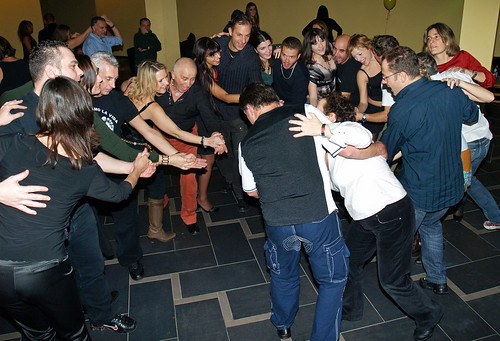
 I am not thinking about the movie but about dance, especially salsa. I remember my dance teachers say that when you dance salsa in couples, the guy takes the lead and the girl has to follow him. And this is a common point among different salsa dance styles. And this idea somehow was not clear for me until I heard a Cuban teacher said that the guy would take the lead in order to make the girl shine bright. Furthermore, he is supposed to smile at her and make her feel great so that you will naturally respond to this “suggestion” smiling and will look charming. It sounds interesting for me: a good metaphor that illustrates how I understand leadership, a relationship of mutual influence that implies that he is not the leader and she is not a follower where dancers are part of an entity that achieves a specific goal, enjoying dancing salsa for instance. The fascinating thing is that when you see or dance salsa, you cannot be aware of this leadership; you are just enjoying the dance.
You can consider that this is not an adequate example, because it is based on a duo. But I can continue with another salsa style, “rueda de casino”. This is a dance performed in couples, have you ever seen it?
 Well, there are pairs that form a circle and dance and, when a caller/leader of the group makes a sign, they exchange partners without loosing the rhythm. And, any naïve spectator will not realize how they do it, you just know they are doing such a wonderful performance, with a precise coordination where the ability of individuals and the group is mise-en-scène! What is going on there? I believe that besides time to practice, to have such a performance, everybody knows his/her role (dance steps and times) as well as the caller assumes is one of them but also has a leader role and dancers trust their leader and the actions he/she will guide.
Maybe I am relating this situation with what I have seen in many organizations, where the minimal unit is a team, under the guidance of a manager who is supposed to be a leader, most of the times. You can observe, in the best performance teams, that they are doing a great job and you will only notice what happened when you ask the leader what she/he has done. I believe that there is more than team member’s mastery and commitment with his/her duties, and the acceptance of the legitimacy of the leader. I dare to say that mutual collaboration and trust on each other’s commitment makes these teams achieve their goals.
Monday, October 6, 2008
Another Look at "Social Responsibility"
Even before our discussion in class last week, I have been particularly interested in corporate social responsibility. Val brought it to my attention after class, that after one of my usual rants (the one that included Ben and Jerry’s… yes, I realize that there were many and I appreciate your patience with me) that I indicated that I was so moved by their talk at Vanderbilt last year that left the Student Center having a complete understanding “of what I want to do with my life”. It wasn’t until Val brought it up that I recognized that I never clarified what that was- and maybe it was in the interest of time, or out of a desire to not loose my train of thought. Either way, I think it is that interest that also propels this Blog entry, and so I apologize in advance if it sounds rather dramatic. And so to answer your question Val, I do not want to be a professional ice cream scooper or even better, taster, (although I agree with you that that would be fun!) but rather I am intrigued by Ben and Jerry’s attempts at incorporating “social responsibility” into their primary vision and I would love to pursue consulting with the intention of directing organizations about how to integrate (into their existing processes) “socially responsible” elements. That being said, I am sorry for the life story, here is where I think this fits in to our class work:
Although I recognize that Milton Friedman does have some valid points about the problem with compromising profits in the name of an “artificial responsibility” [considering that “only people can have responsibilities”] I believe that the two are not mutually exclusive. Aside from the Ben and Jerry’s example, couldn’t we imagine a situation in which it would be in the organization’s best interest (i.e. increased profits) to act socially responsible? Independent from the (still) mysterious Body Shop woman’s promise to donating 5% of her profits to charity, what if we followed Don Quijote’s example of an imaginative leader (aha! a good example of where this principle could be beneficial if controlled!) and found a way for ‘social responsibility’ to benefit both parties without risking profit.
To kick start this idea, lets imagine a small business, “X”, is interested in introducing a new candy bar. Their target consumer is between ages 15-18. Business “X”, before releasing their candy bar, wants to ensure that their target demographic understands what the candy bar is and why it is better than other candy bars on the market + wants to get them to by this candy bar = recognizes the necessity to conduct market research. In the past, organizations might employ an external marketing organization to conduct a research study, compile a focus group, compare their competitor’s strategies etc. Although these have been successful for many businesses, one limitation has been revealing avenues to directly communicate to the consumer. So here is where this idea of “social responsibility” could be integrated into business “X’s existing processes…who better to understand what the audience wants and needs than someone in that audience? Why couldn’t business “X” depend on a high school aged “Ivan intern” (at no cost to them) to disseminate information about the candy bar, educate business “X’s” marketing team about their audience, relate to the customer, and more adequately explain the value proposition of the product? Wouldn’t this give business “X” the marketing scope and audience understanding they need to be successful while also expanding their opportunities to directly reach their target audience? Doesn’t this also allow “Ivan intern” to put a highly valued career experience on his resume? And isn’t this benefit heightened if Ivan aspired to go to college but is from an under resourced school where extracurricular opportunities are limited? I recognize that there are limitations to this example, i.e. Ivan’s ability to perform these tasks effectively and the time taken to train him but couldn’t we really get somewhere with this?
Another example. What is stopping Fido’s (coffee shop on 21st; I highly recommend it) from hosting an event organized by Children’s Hospital volunteers to make slippers for patients? The Children’s Hospital uses Fido’s space (brings all of the necessary supplies) and benefits from Fido’s existing popularity and name recognition. Meanwhile Fido’s increases their profit (immediately because of the increased traffic flow through their store on the day of the event and after in establishing a new clientele base/support).
Another example. The Vanderbilt women’s lacrosse team decides to “adopt” an 11 year old girl with brain cancer. This adoption includes having Makenzie appear at games and sit on the sideline with the team, giving extra Vanderbilt gear to her and her younger brother, inviting her family to the end of the year celebration banquet etc. Makenzie benefits from the love and support the team offers her and her family (without doing anything extra but including her in what is already expected of the team) and the team finds some extra energy and motivation to appreciate the game, their teammates, and the health of their bodies… and, if they are lucky, like Northwestern (who has won four national championships since the year they “adopted” Jacklyn) they might find their love and care for another translates into success.
Regardless of the type of business or team, organizations have a collective power, (money, resources, support) to do what people cannot on their own. If, in agreement with the contingency theory, an organization is equally affected by the external environment as the situations, transactions, processes etc. that occur within, I argue that it is exceedingly important to cultivate abundant and healthy and relationships with external parties (i.e. the community). Rather than expect public service or “social responsibility” to consume profit, let’s explore ways that we can accomplish both: allow “corporate social responsibility” to penetrate existing processes and consequently if not increase profit, at least maintain what would be gained without integrating socially responsible ideals.
As long as we can find ways for organizations to minimize the “transaction cost” of integrating such “socially responsible” events into corporate processes I am confident that we could cultivate a new corporate culture- one that enhances the communities of which these businesses are a part without compromising profits. And who better to start these movements than the leaders of these organizations? I am not suggesting that this “vision” for transforming corporate America need be created and maintained solely by the leaders: that it is limited by “providing a vision and influencing others to realize it through non-coercive means” (Heifitz, 1994). Rather if our current short-comings in not taking advantage of businesses’ collective power is a problem (and I argue that it is), the solution should not come from leaders who exclusively influence “the community to follow their vision” but from those that “influence the community to face its problems” (Heifitz, 1994). This style of leadership would look more like Sashkin’s model (oh the “e”s = express, explain, extend, expand) with a modified “first step” (Sashkin, 1989). Without going into all of them, I suggest a “modified step” that (rather than encouraging others to be committed to “the leader’s vision”) requires a leader to “focus others’ attention on key issues [the lack of corporate social responsibility]- helping people grasp, understand and become committed” to the cause: thus depending on “effective followers” to collaboratively create a vision (Sashkin, 1989; Kelly, 1998). With this adjustment, I think Sashkin’s outline of effective leadership would be very valuable in this situation especially in that it allows followers to be “empowered” to affect real change. Change that does not separate from the bottom line, but embraces a socially responsible means to enhance it.
“Never doubt that a small group of thoughtful, committed people can change the world. Indeed, it is the only thing that ever has.”
Margaret Mead
Although I recognize that Milton Friedman does have some valid points about the problem with compromising profits in the name of an “artificial responsibility” [considering that “only people can have responsibilities”] I believe that the two are not mutually exclusive. Aside from the Ben and Jerry’s example, couldn’t we imagine a situation in which it would be in the organization’s best interest (i.e. increased profits) to act socially responsible? Independent from the (still) mysterious Body Shop woman’s promise to donating 5% of her profits to charity, what if we followed Don Quijote’s example of an imaginative leader (aha! a good example of where this principle could be beneficial if controlled!) and found a way for ‘social responsibility’ to benefit both parties without risking profit.
To kick start this idea, lets imagine a small business, “X”, is interested in introducing a new candy bar. Their target consumer is between ages 15-18. Business “X”, before releasing their candy bar, wants to ensure that their target demographic understands what the candy bar is and why it is better than other candy bars on the market + wants to get them to by this candy bar = recognizes the necessity to conduct market research. In the past, organizations might employ an external marketing organization to conduct a research study, compile a focus group, compare their competitor’s strategies etc. Although these have been successful for many businesses, one limitation has been revealing avenues to directly communicate to the consumer. So here is where this idea of “social responsibility” could be integrated into business “X’s existing processes…who better to understand what the audience wants and needs than someone in that audience? Why couldn’t business “X” depend on a high school aged “Ivan intern” (at no cost to them) to disseminate information about the candy bar, educate business “X’s” marketing team about their audience, relate to the customer, and more adequately explain the value proposition of the product? Wouldn’t this give business “X” the marketing scope and audience understanding they need to be successful while also expanding their opportunities to directly reach their target audience? Doesn’t this also allow “Ivan intern” to put a highly valued career experience on his resume? And isn’t this benefit heightened if Ivan aspired to go to college but is from an under resourced school where extracurricular opportunities are limited? I recognize that there are limitations to this example, i.e. Ivan’s ability to perform these tasks effectively and the time taken to train him but couldn’t we really get somewhere with this?
Another example. What is stopping Fido’s (coffee shop on 21st; I highly recommend it) from hosting an event organized by Children’s Hospital volunteers to make slippers for patients? The Children’s Hospital uses Fido’s space (brings all of the necessary supplies) and benefits from Fido’s existing popularity and name recognition. Meanwhile Fido’s increases their profit (immediately because of the increased traffic flow through their store on the day of the event and after in establishing a new clientele base/support).
Another example. The Vanderbilt women’s lacrosse team decides to “adopt” an 11 year old girl with brain cancer. This adoption includes having Makenzie appear at games and sit on the sideline with the team, giving extra Vanderbilt gear to her and her younger brother, inviting her family to the end of the year celebration banquet etc. Makenzie benefits from the love and support the team offers her and her family (without doing anything extra but including her in what is already expected of the team) and the team finds some extra energy and motivation to appreciate the game, their teammates, and the health of their bodies… and, if they are lucky, like Northwestern (who has won four national championships since the year they “adopted” Jacklyn) they might find their love and care for another translates into success.
Regardless of the type of business or team, organizations have a collective power, (money, resources, support) to do what people cannot on their own. If, in agreement with the contingency theory, an organization is equally affected by the external environment as the situations, transactions, processes etc. that occur within, I argue that it is exceedingly important to cultivate abundant and healthy and relationships with external parties (i.e. the community). Rather than expect public service or “social responsibility” to consume profit, let’s explore ways that we can accomplish both: allow “corporate social responsibility” to penetrate existing processes and consequently if not increase profit, at least maintain what would be gained without integrating socially responsible ideals.
As long as we can find ways for organizations to minimize the “transaction cost” of integrating such “socially responsible” events into corporate processes I am confident that we could cultivate a new corporate culture- one that enhances the communities of which these businesses are a part without compromising profits. And who better to start these movements than the leaders of these organizations? I am not suggesting that this “vision” for transforming corporate America need be created and maintained solely by the leaders: that it is limited by “providing a vision and influencing others to realize it through non-coercive means” (Heifitz, 1994). Rather if our current short-comings in not taking advantage of businesses’ collective power is a problem (and I argue that it is), the solution should not come from leaders who exclusively influence “the community to follow their vision” but from those that “influence the community to face its problems” (Heifitz, 1994). This style of leadership would look more like Sashkin’s model (oh the “e”s = express, explain, extend, expand) with a modified “first step” (Sashkin, 1989). Without going into all of them, I suggest a “modified step” that (rather than encouraging others to be committed to “the leader’s vision”) requires a leader to “focus others’ attention on key issues [the lack of corporate social responsibility]- helping people grasp, understand and become committed” to the cause: thus depending on “effective followers” to collaboratively create a vision (Sashkin, 1989; Kelly, 1998). With this adjustment, I think Sashkin’s outline of effective leadership would be very valuable in this situation especially in that it allows followers to be “empowered” to affect real change. Change that does not separate from the bottom line, but embraces a socially responsible means to enhance it.
“Never doubt that a small group of thoughtful, committed people can change the world. Indeed, it is the only thing that ever has.”
Margaret Mead
Friday, October 3, 2008
Authoritative Style
Just a tidbit of a comment below.
The authoritative style of leadership is more dictatorial than its actual definition because it is derived from the word "authority." Though "authoritative" denotes a negative style of leading, it is a psychological term that describes different parenting styles. An authoritative parenting style should be discerned from the "authoritarian." I do not know whether the leadership term is derived from the psychological meaning, but it was the first thing I thought of when hearing of this in Goleman's work.
Authoritarian parents are highly demanding and directive, but not responsive. "They are obedience- and status-oriented, and expect their orders to be obeyed without explanation" (Baumrind, 1991, p. 62). These parents provide well-ordered and structured environments with clearly stated rules. Authoritarian parents can be divided into two types: nonauthoritarian-directive, who are directive, but not intrusive or autocratic in their use of power, and authoritarian-directive, who are highly intrusive.
Authoritative parents are both demanding and responsive. "They monitor and impart clear standards for their children’s conduct. They are assertive, but not intrusive and restrictive. Their disciplinary methods are supportive, rather than punitive. They want their children to be assertive as well as socially responsible, and self-regulated as well as cooperative" (Baumrind, 1991, p. 62).
citation: http://www.athealth.com/Practitioner/ceduc/parentingstyles.html
The authoritative style of leadership is more dictatorial than its actual definition because it is derived from the word "authority." Though "authoritative" denotes a negative style of leading, it is a psychological term that describes different parenting styles. An authoritative parenting style should be discerned from the "authoritarian." I do not know whether the leadership term is derived from the psychological meaning, but it was the first thing I thought of when hearing of this in Goleman's work.
Authoritarian parents are highly demanding and directive, but not responsive. "They are obedience- and status-oriented, and expect their orders to be obeyed without explanation" (Baumrind, 1991, p. 62). These parents provide well-ordered and structured environments with clearly stated rules. Authoritarian parents can be divided into two types: nonauthoritarian-directive, who are directive, but not intrusive or autocratic in their use of power, and authoritarian-directive, who are highly intrusive.
Authoritative parents are both demanding and responsive. "They monitor and impart clear standards for their children’s conduct. They are assertive, but not intrusive and restrictive. Their disciplinary methods are supportive, rather than punitive. They want their children to be assertive as well as socially responsible, and self-regulated as well as cooperative" (Baumrind, 1991, p. 62).
citation: http://www.athealth.com/Practitioner/ceduc/parentingstyles.html
Sunday, September 28, 2008
Milgram's Influence
There was a story on singer Dar Williams on NPR this morning; I was fascinated to hear her discuss her new song called "Buzzer" inspired by the Milgram experiments; you can listen to it here: http://www.npr.org/templates/story/story.php?storyId=95082381
Wednesday, September 24, 2008
Leadership Theory and Gang Persistence
A cautionary note anchors this discussion. This discussion in no way promotes or justifies the formation and/or survival of gangs and/or gang related activities.
After reading for class, I turned on the TV and began to watch a program called Gangland on the History channel. The program primarily focused on the origin and workings of the Bloods, a gang based in New York with smaller affiliations predominately in New Jersey and Baltimore. In addition, the program also focused on the key leader of the gang, Omar Portee aka O.G. Mack. Different explanations were offered for the persistence of gangs despite efforts by multiple facets of law enforcement to dismantle these organizations. It is evident that the leadership and structure of gangs are instrumental in explaining the persistence of not just the Bloods but also various gangs across the country. Several aspects of charismatic leadership as well as specific characteristics of followers may provide insight to the origins of gangs and answer the questions of how and why they survive.
Choi explains key aspects of charismatic leadership, in which the leader is effective in addressing the followers’ need for power, affiliation, and achievement. In 1993 in Rikers Island, one of New York City’s largest jail facilities, O.G. Mack created the United Blood Nation (UBN) as a way to protect African American inmates from the Latin Kings, which was the most prevalent gang in the jail system at the time. Based on Choi’s conclusions, O.G. Mack was able to capitalize on African American inmates’ need for power in relation to that of the Latin Kings, need for affiliation with a group of inmates who shared common views, and finally their need for achievement within the prison system. Another critical aspect of gang formation coincides with the notion that followers are committed to the organization and to a purpose or principle (Kelly, 1988). In this particular case, Blood members were committed to the ultimate purpose of the organization, which was to create and maintain a network of protection. Although that was the primary purpose of the gang, as members were paroled and returned to their communities, the purpose of the organization steered in the direction of personal and to a lesser extent communal economic achievement. With this new purpose, the new wave of gang members were drawn in due to the leaders’ ability to effectively satisfy the needs of members who felt alienated from society based on racial and/or socioeconomic status. For these gang members, their affiliation with the UBN provided a source of empowerment and fostered their personal ideals of achievement. In a sentence, several aspects of charismatic leadership with respect to gang leaders are apparent in the formation of gangs.
In light of the discussion above, law enforcement officials usually pay close attention to the leaders of gangs with the perception that eliminating the source will inevitably dismantle the entire organization. Despite these efforts, which usually result in the incarceration of gang leaders, gangs continue to persist. The conclusions about the leadership relationship between leaders and followers as proposed by Rost offer a possible explanation for gang survival. Rost argues that followers can become leaders and vice versa in any leadership relationship. He also argues that only people who are active in the leadership process are followers. Accordingly, gang members who are active in the leadership process, though not formally recognized as leaders, have the potential to become the next leader in the event of absent leadership. The fluidity of the leadership continuum exhibited in the structure of gangs allows for gang members to assume leadership, thus sustaining the organization. It is pertinent to note that as a result of this leadership continuum, the potential for gangs to become institutionalized is not unlikely. Therefore despite changes in leadership, gangs are able to survive for years and in some cases decades.
Considering the leadership and structure of gangs, they should be perceived as having an organizational hierarchy similar to that of corporate companies. Within this framework, gangs have both an established chain of command and interchangeable leader and follower positions. In an organization where leadership is not static and there is a leadership relationship with active and effective followers, eradicating such an organization may be more complicated. Therefore, it is a naïve line of reasoning that eliminating the leadership of gangs will dismantle the organization. Similarly, firing the CEO and Board of Trust, will not dismantle an entire company if there are followers that are effective in assuming leadership. As many studies on gang suppression suggest, it may prove more effective to focus on prevention and/or remediation programs that address prospective and current gang members’ need for power, affiliation, and achievement.
After reading for class, I turned on the TV and began to watch a program called Gangland on the History channel. The program primarily focused on the origin and workings of the Bloods, a gang based in New York with smaller affiliations predominately in New Jersey and Baltimore. In addition, the program also focused on the key leader of the gang, Omar Portee aka O.G. Mack. Different explanations were offered for the persistence of gangs despite efforts by multiple facets of law enforcement to dismantle these organizations. It is evident that the leadership and structure of gangs are instrumental in explaining the persistence of not just the Bloods but also various gangs across the country. Several aspects of charismatic leadership as well as specific characteristics of followers may provide insight to the origins of gangs and answer the questions of how and why they survive.
Choi explains key aspects of charismatic leadership, in which the leader is effective in addressing the followers’ need for power, affiliation, and achievement. In 1993 in Rikers Island, one of New York City’s largest jail facilities, O.G. Mack created the United Blood Nation (UBN) as a way to protect African American inmates from the Latin Kings, which was the most prevalent gang in the jail system at the time. Based on Choi’s conclusions, O.G. Mack was able to capitalize on African American inmates’ need for power in relation to that of the Latin Kings, need for affiliation with a group of inmates who shared common views, and finally their need for achievement within the prison system. Another critical aspect of gang formation coincides with the notion that followers are committed to the organization and to a purpose or principle (Kelly, 1988). In this particular case, Blood members were committed to the ultimate purpose of the organization, which was to create and maintain a network of protection. Although that was the primary purpose of the gang, as members were paroled and returned to their communities, the purpose of the organization steered in the direction of personal and to a lesser extent communal economic achievement. With this new purpose, the new wave of gang members were drawn in due to the leaders’ ability to effectively satisfy the needs of members who felt alienated from society based on racial and/or socioeconomic status. For these gang members, their affiliation with the UBN provided a source of empowerment and fostered their personal ideals of achievement. In a sentence, several aspects of charismatic leadership with respect to gang leaders are apparent in the formation of gangs.
In light of the discussion above, law enforcement officials usually pay close attention to the leaders of gangs with the perception that eliminating the source will inevitably dismantle the entire organization. Despite these efforts, which usually result in the incarceration of gang leaders, gangs continue to persist. The conclusions about the leadership relationship between leaders and followers as proposed by Rost offer a possible explanation for gang survival. Rost argues that followers can become leaders and vice versa in any leadership relationship. He also argues that only people who are active in the leadership process are followers. Accordingly, gang members who are active in the leadership process, though not formally recognized as leaders, have the potential to become the next leader in the event of absent leadership. The fluidity of the leadership continuum exhibited in the structure of gangs allows for gang members to assume leadership, thus sustaining the organization. It is pertinent to note that as a result of this leadership continuum, the potential for gangs to become institutionalized is not unlikely. Therefore despite changes in leadership, gangs are able to survive for years and in some cases decades.
Considering the leadership and structure of gangs, they should be perceived as having an organizational hierarchy similar to that of corporate companies. Within this framework, gangs have both an established chain of command and interchangeable leader and follower positions. In an organization where leadership is not static and there is a leadership relationship with active and effective followers, eradicating such an organization may be more complicated. Therefore, it is a naïve line of reasoning that eliminating the leadership of gangs will dismantle the organization. Similarly, firing the CEO and Board of Trust, will not dismantle an entire company if there are followers that are effective in assuming leadership. As many studies on gang suppression suggest, it may prove more effective to focus on prevention and/or remediation programs that address prospective and current gang members’ need for power, affiliation, and achievement.
Tuesday, September 23, 2008
Leadership Analysis of an Organization
The following is a critical analysis of the leadership within faith-based organization of which I have become aware through a direct source.
Stituation.
In an email preceding the first organizational leadership meeting nominees for an elected position, which would be voted upon and decided during the meeting, were named. All persons who had been nominated were of the male gender. It was humorously noted in the email that, although qualified females were present available, the nominations made were all male due to the fact that the current executive committee consisted entirely of females and “diversity [would be] a good thing.”
During the organizational leadership meeting, the nominees were asked to make a speech regarding their reasons for seeking the position. Afterwards, the nominees were led outside of the classroom in order to allow for voting to take place. Before voting began, the presiding officer of the election asked fellow voters if they would like to engage in discussion regarding the nominations. Going through the list of names, the presiding officer asked ‘if anyone had any thoughts they would like to share.’ Although few persons expressed desire to discuss the election matter, the officer continued to list out the names of the nominees, pausing briefly after each name to allow for any comments to be made. Towards the end of the list of nominees, the presiding officer paused after reading the name of the only African American nominee and briefly reemphasized the “need” for diversity. No other nominee was discussed in any extent in any context.
The vote, decided by a show-of-hands, determined the African American nominee as the new representative. Before bringing the nominees back into the room, the officer briefly reminded students of the “confidentiality” of voting procedures.
Analysis.
In an analysis of the organizational patterns described above, it is apparent that the leadership is in a critical need of reevaluation and reform. The organization’s actions in disqualifying qualified female candidates to an elected position, and showing a preference to a certain candidate solely on the basis of race are dangerous signals of the presence sexist and racist practices. Yet no group members made any apparent vocal objection to the organizational procedures. How did this happen?
The leadership behaviors of this organization manifested characteristics of groupthink. According to Janis, "laughing together about a danger signal, which labels it as a purely laughing matter," is a manifestation of groupthink (Janis, 1971). This is clearly present in the email sent to members of the group before the organizational meeting. Belittling the idea that women were excluded from an election in favor of “diversity” is a danger signal. The members of the group seemed to believe unquestioningly in an “inherent morality” of the group, and have allowed ethical and moral consequences of their actions to be ignored (Janis, 1971).
The presiding officer of the election further encouraged groupthink during the organizational meeting by initiating public discussions regarding the nominees. Group members were unlikely to voice descending opinions about either the nominees or discomfort with the lack professionalism in procedural matters due to “binding factors” such as politeness, awkwardness of withdrawal, and a desire to uphold initial promise of participation, which can trap a person into “concurrence seeking” norms (Milgram, 1974; Janis, 1971). Particularly in a public forum, an “illusion of unanimity” can become very dominant, encouraging group members with dissenting opinions to practice self-censorship (Scharff, 1995). The “illusion of unanimity” is strengthened by the school of thought that “any individual who remains silent [...] is in full accord with what others are saying” (Janis 1971). The show-of-hands voting procedure was another powerful endorsement of groupthink, as it is very difficult to escape powerful psychological pressures of a group particularly when one is voting publicly within a group.
Conclusions.
This is a very pertinent example of why good leadership is needed, even in organizations which are not perhaps as prominent as the corporations or government operations we often read about within the context of our class. A continuation of groupthink behavior can lead to an overall culture of discontent within a group, despite members being unwilling to voice their dissent. It can lead unethical decision making and moral questions regarding the mission of the organization as a whole. Corrupt organizational procedures can also be detrimental to persons who became leaders through such means, regardless of lack of awareness to the situation and their qualifications and expertise.
Stituation.
In an email preceding the first organizational leadership meeting nominees for an elected position, which would be voted upon and decided during the meeting, were named. All persons who had been nominated were of the male gender. It was humorously noted in the email that, although qualified females were present available, the nominations made were all male due to the fact that the current executive committee consisted entirely of females and “diversity [would be] a good thing.”
During the organizational leadership meeting, the nominees were asked to make a speech regarding their reasons for seeking the position. Afterwards, the nominees were led outside of the classroom in order to allow for voting to take place. Before voting began, the presiding officer of the election asked fellow voters if they would like to engage in discussion regarding the nominations. Going through the list of names, the presiding officer asked ‘if anyone had any thoughts they would like to share.’ Although few persons expressed desire to discuss the election matter, the officer continued to list out the names of the nominees, pausing briefly after each name to allow for any comments to be made. Towards the end of the list of nominees, the presiding officer paused after reading the name of the only African American nominee and briefly reemphasized the “need” for diversity. No other nominee was discussed in any extent in any context.
The vote, decided by a show-of-hands, determined the African American nominee as the new representative. Before bringing the nominees back into the room, the officer briefly reminded students of the “confidentiality” of voting procedures.
Analysis.
In an analysis of the organizational patterns described above, it is apparent that the leadership is in a critical need of reevaluation and reform. The organization’s actions in disqualifying qualified female candidates to an elected position, and showing a preference to a certain candidate solely on the basis of race are dangerous signals of the presence sexist and racist practices. Yet no group members made any apparent vocal objection to the organizational procedures. How did this happen?
The leadership behaviors of this organization manifested characteristics of groupthink. According to Janis, "laughing together about a danger signal, which labels it as a purely laughing matter," is a manifestation of groupthink (Janis, 1971). This is clearly present in the email sent to members of the group before the organizational meeting. Belittling the idea that women were excluded from an election in favor of “diversity” is a danger signal. The members of the group seemed to believe unquestioningly in an “inherent morality” of the group, and have allowed ethical and moral consequences of their actions to be ignored (Janis, 1971).
The presiding officer of the election further encouraged groupthink during the organizational meeting by initiating public discussions regarding the nominees. Group members were unlikely to voice descending opinions about either the nominees or discomfort with the lack professionalism in procedural matters due to “binding factors” such as politeness, awkwardness of withdrawal, and a desire to uphold initial promise of participation, which can trap a person into “concurrence seeking” norms (Milgram, 1974; Janis, 1971). Particularly in a public forum, an “illusion of unanimity” can become very dominant, encouraging group members with dissenting opinions to practice self-censorship (Scharff, 1995). The “illusion of unanimity” is strengthened by the school of thought that “any individual who remains silent [...] is in full accord with what others are saying” (Janis 1971). The show-of-hands voting procedure was another powerful endorsement of groupthink, as it is very difficult to escape powerful psychological pressures of a group particularly when one is voting publicly within a group.
Conclusions.
This is a very pertinent example of why good leadership is needed, even in organizations which are not perhaps as prominent as the corporations or government operations we often read about within the context of our class. A continuation of groupthink behavior can lead to an overall culture of discontent within a group, despite members being unwilling to voice their dissent. It can lead unethical decision making and moral questions regarding the mission of the organization as a whole. Corrupt organizational procedures can also be detrimental to persons who became leaders through such means, regardless of lack of awareness to the situation and their qualifications and expertise.
Sunday, September 21, 2008
For the Law & Order SVU fans
Hello everyone,
Yes, I am posting at midnight on a Saturday night. I was just finishing up watching another Saturday of college football (including a Vandy victory to stay undefeated) when I stumbled upon yet another episode of Law & Order SVU on USA. I promise I am not just telling you all what I do on the weekends for no good reason. In this particular episode, Robin Williams makes an appearance as a very disturbed individual who believed that everyone in society has become "sheep" following "shepherds," doing as they are told and never questioning the system. As the show progresses, he takes one of the detectives, Olivia Benson, hostage. When her partner arrives, Robin Williams demands that he participate in a "real" version of the Milgram experiment or else Williams will blow up the entire building. He says that the only way he will let them both go is if the detective presses the button to shock his partner. The detective continually refuses to participate and Williams eventually confesses that the button did not actually shock her and that there was no bomb in the building. Williams also thanked the detective for being a "human," because in his past experience, cops and doctors were the ones who most abused the power as "shepherds." Just in case you were wondering how the show ends, Williams does actually blow up the building once the three of them are safely outside, which allowed him to escape their custody.
I thought it was interesting to see the Milgram experiment show up in a current, very popular television show and wanted to share my viewing experience with all of you. I hope everyone is having a great weekend and I will see you all on Wednesday.
Yes, I am posting at midnight on a Saturday night. I was just finishing up watching another Saturday of college football (including a Vandy victory to stay undefeated) when I stumbled upon yet another episode of Law & Order SVU on USA. I promise I am not just telling you all what I do on the weekends for no good reason. In this particular episode, Robin Williams makes an appearance as a very disturbed individual who believed that everyone in society has become "sheep" following "shepherds," doing as they are told and never questioning the system. As the show progresses, he takes one of the detectives, Olivia Benson, hostage. When her partner arrives, Robin Williams demands that he participate in a "real" version of the Milgram experiment or else Williams will blow up the entire building. He says that the only way he will let them both go is if the detective presses the button to shock his partner. The detective continually refuses to participate and Williams eventually confesses that the button did not actually shock her and that there was no bomb in the building. Williams also thanked the detective for being a "human," because in his past experience, cops and doctors were the ones who most abused the power as "shepherds." Just in case you were wondering how the show ends, Williams does actually blow up the building once the three of them are safely outside, which allowed him to escape their custody.
I thought it was interesting to see the Milgram experiment show up in a current, very popular television show and wanted to share my viewing experience with all of you. I hope everyone is having a great weekend and I will see you all on Wednesday.
Wednesday, September 17, 2008
A few more remarks to make on today's class.
"Organization emerges from nowhere but communication." I like this notion,and the idea of "emerge" in particular.We've been talking about the formation of the organizational vision: Where does it come from? Does the leader conceive it on his/her own or is it resulted from the interaction between the leader and the followers? I think one thing we need to keep in mind when addressing this kind of questions is the numerous types of organizations and leadship there can be.Leadership is so inclusive a concept that sometimes it's easy to overlook its nuances in meaning when used in different contexts.Again, definition matters.
Literally, every organzation presents a unique picture. The way vision is formed varies accordingly as variables such as organizational purpose and members'expectation of organizational effectiveness change.To have a clearer sense of the nature of the organization under discussion (which serves as the basis of further analysis) ,it might be a good idea to begin with questions like "why do people join this organization in the first place?" As some of you have pointed out in class, sometimes people choose to join a group and follow a certain leader because they share his/her professed vision. More often this happens to informal organizations and grass-root leaders.
"Organization emerges from nowhere but communication." I like this notion,and the idea of "emerge" in particular.We've been talking about the formation of the organizational vision: Where does it come from? Does the leader conceive it on his/her own or is it resulted from the interaction between the leader and the followers? I think one thing we need to keep in mind when addressing this kind of questions is the numerous types of organizations and leadship there can be.Leadership is so inclusive a concept that sometimes it's easy to overlook its nuances in meaning when used in different contexts.Again, definition matters.
Literally, every organzation presents a unique picture. The way vision is formed varies accordingly as variables such as organizational purpose and members'expectation of organizational effectiveness change.To have a clearer sense of the nature of the organization under discussion (which serves as the basis of further analysis) ,it might be a good idea to begin with questions like "why do people join this organization in the first place?" As some of you have pointed out in class, sometimes people choose to join a group and follow a certain leader because they share his/her professed vision. More often this happens to informal organizations and grass-root leaders.
".Superstar CEO"
Upon reflection of the latest articles for class discussing charismatic leadership, I have noticed a rather detrimental pattern that my undergraduate alma mater, Fisk University, exudes whenever a new person is placed into a position of power. For example, the current President of Fisk University, Hazel O’Leary came into office in 2004. There was much discussion about what she could bring to the university because of her background, especially her position as Secretary of Energy during William Clinton’s presidency. Fisk University, being in a constant state of financial crisis, needed a leader to bring Fisk out of the financial turmoil and into some form of stability. Looking back, President O’Leary was viewed as a "superstar CEO" by the university. Everyone hoped she would be the savior and save the university.
With the "Superstar CEO" mentality mentioned in the article by Rakesh Khurana, all responsibility is surrendered to the person in charge, including the blame if need be. Depending on the outcome of the organization depicts whether the "Superstar CEO" will be seen as a hero, one who conquered all, or as a villain, a mere scapegoat (Khurana, 2002). This ideology coincided with Stanley Milgram’s article on obedience in reference to the legitimate authority. Once the followers view the authority figure as "legitimate" then individual responsibility is no longer considered necessary. Followers will then attribute their actions to the authority figure; they were simply following instruction (Milgram, 1974). Because everything is construed as at the mercy of the authority figure, the follower may view his or herself as a mere vessel to execute the leader’s vision and/or work.
Unfortunately, Khurana also included many examples of how this perception is skewed because oftentimes placing the larger than life authority head on a pedestal only leaves ample space below to tumble down (Khurana, 2002). After four years serving as president, Fisk University is still in the same state, if not worse, than when President O’Leary came into office. The president of Fisk seems to be trying to hoist the entire university on her shoulders. She cannot possibly save the university by herself, right? Is it even fair to ask her to assume that role by herself? Why would people sacrifice their own choice (dare I say obligation) to contribute to accomplishing goals that affect everyone?
In Clayborn Carson’s discussion about Martin Luther King Jr., he made a valid point that while many people idolize King, he did not wage the war on civil rights by himself. There were many unspoken leaders and contributors to the movement that made their decisions on their own; not because of King (Carson, 1987). This demonstrates that while there may be someone serving as a "face" for an organization or movement, that it is not solely their actions that makes a difference, but a collective effort. Instead of sitting back and waiting for someone to come save us, why not take action to improve what we can for ourselves? That is the message I would transmit to Fisk University, to people thinking their vote does not count, or anyone who feels that they cannot make a difference. A step in the right direction is better than no step at all because it still symbolizes a conscious decision to change. `
With the "Superstar CEO" mentality mentioned in the article by Rakesh Khurana, all responsibility is surrendered to the person in charge, including the blame if need be. Depending on the outcome of the organization depicts whether the "Superstar CEO" will be seen as a hero, one who conquered all, or as a villain, a mere scapegoat (Khurana, 2002). This ideology coincided with Stanley Milgram’s article on obedience in reference to the legitimate authority. Once the followers view the authority figure as "legitimate" then individual responsibility is no longer considered necessary. Followers will then attribute their actions to the authority figure; they were simply following instruction (Milgram, 1974). Because everything is construed as at the mercy of the authority figure, the follower may view his or herself as a mere vessel to execute the leader’s vision and/or work.
Unfortunately, Khurana also included many examples of how this perception is skewed because oftentimes placing the larger than life authority head on a pedestal only leaves ample space below to tumble down (Khurana, 2002). After four years serving as president, Fisk University is still in the same state, if not worse, than when President O’Leary came into office. The president of Fisk seems to be trying to hoist the entire university on her shoulders. She cannot possibly save the university by herself, right? Is it even fair to ask her to assume that role by herself? Why would people sacrifice their own choice (dare I say obligation) to contribute to accomplishing goals that affect everyone?
In Clayborn Carson’s discussion about Martin Luther King Jr., he made a valid point that while many people idolize King, he did not wage the war on civil rights by himself. There were many unspoken leaders and contributors to the movement that made their decisions on their own; not because of King (Carson, 1987). This demonstrates that while there may be someone serving as a "face" for an organization or movement, that it is not solely their actions that makes a difference, but a collective effort. Instead of sitting back and waiting for someone to come save us, why not take action to improve what we can for ourselves? That is the message I would transmit to Fisk University, to people thinking their vote does not count, or anyone who feels that they cannot make a difference. A step in the right direction is better than no step at all because it still symbolizes a conscious decision to change. `
Tuesday, September 2, 2008
Leaders Finding Leaders
STRENGTHS BASED MANAGEMENT – LEADERS FINDING LEADERS THROUGH POSITIVE PERCEPTION
By:
Woodrow Lucas
Heifitz, Burns, Mcgregor, and Selznick, intersect in their rejection of the obfuscating and dichotomous argument of whether leaders are born or made, and embrace more useful definitions to include but not limited to adaptive work, resource mobilization, social change agency, and the instigation of practical and moral evolution (Burns, 1978; Heifitz, 1991; McGregor, 1966; Selznick, 1975). These four authors aptly depict leadership as an activity rather than an a priori state, and at least imply that as an activity it can be nurtured, taught, and facilitated.
Burns and later Gardener assert that both leaders and followers are subject to “political and cultural” forces (Burns, 1978; Gardener 1990) and that leaders and followers interdependently share a common destiny, yet all of the authors conspicuously omit the reality that leaders can foster other leaders to share their vision. In other words, all of the analysis treat leadership as an individual phenomena, when it essence it may be “groups” of leaders or” leaders who lead leaders that subsequently lead followers” that most substantively influence organizations and societies toward good ends. “Strengths Based Management” provides a heuristic lens through which we can understand how leaders can create and lead other leaders. A strengths based management approach enables a leader to discover subordinates and/or peers sympathetic to an effective and evolutionary agenda, consequently increasing their effectiveness.
Martin Seiigmann and Edward Diener were among the first to propose the notion that effective management endeavors to focus on “aspects of work organization that lead to success rather than correct failures” (Smedley, 2007). This notion soon evolved into what is now termed “Strengths Based Management”, a management style and praxis that seeks to discern and capitalize on inherent organizational and individual strengths rather than spending energy on remediating deficits. The consensus opinion among most of this week’s authors that there should be a teleological sense of meaning, purpose, and value to leadership rather than a value-neutral sense of “influence” suggests that “true” leadership discerns as well as persuades. Heifitz’ adaptive work model connotes a “challenge” to followers to engage critical issues which face them (Hefitz, 1998). Strengths Based Management also challenges followers and other leaders to engage critical issues, but with a focus on their individual and collective capacity to overcome said issues rather than simply a collective acknowledgement that issues exist.
A working model of adaptive work entails perhaps a different kind of perception, in which one can dialectically discern the best intentions, motivations, and actions among people and mobilize around them. In a sense the effective leader is in touch with the “collective mind” of the people, but has the ability to learn from de facto reality and historical hindsight to sift what is helpful from what is ultimately useless or harmful. Yet notions of delegation and human limitation are neglected in this week’s readings. Can one leader do it all? Or do they need other like-minded leaders? Strengths Based Management is a tool of discernment that equips a leader to discern the best about not only followers, but enables them to detect other leaders who serve the same transformative agenda. By seeing their own assets and then discovering those assets in others, strengths based management empowers the leader to be “part of” rather than “responsible for” effective, positive, and sustainable change.
By:
Woodrow Lucas
Heifitz, Burns, Mcgregor, and Selznick, intersect in their rejection of the obfuscating and dichotomous argument of whether leaders are born or made, and embrace more useful definitions to include but not limited to adaptive work, resource mobilization, social change agency, and the instigation of practical and moral evolution (Burns, 1978; Heifitz, 1991; McGregor, 1966; Selznick, 1975). These four authors aptly depict leadership as an activity rather than an a priori state, and at least imply that as an activity it can be nurtured, taught, and facilitated.
Burns and later Gardener assert that both leaders and followers are subject to “political and cultural” forces (Burns, 1978; Gardener 1990) and that leaders and followers interdependently share a common destiny, yet all of the authors conspicuously omit the reality that leaders can foster other leaders to share their vision. In other words, all of the analysis treat leadership as an individual phenomena, when it essence it may be “groups” of leaders or” leaders who lead leaders that subsequently lead followers” that most substantively influence organizations and societies toward good ends. “Strengths Based Management” provides a heuristic lens through which we can understand how leaders can create and lead other leaders. A strengths based management approach enables a leader to discover subordinates and/or peers sympathetic to an effective and evolutionary agenda, consequently increasing their effectiveness.
Martin Seiigmann and Edward Diener were among the first to propose the notion that effective management endeavors to focus on “aspects of work organization that lead to success rather than correct failures” (Smedley, 2007). This notion soon evolved into what is now termed “Strengths Based Management”, a management style and praxis that seeks to discern and capitalize on inherent organizational and individual strengths rather than spending energy on remediating deficits. The consensus opinion among most of this week’s authors that there should be a teleological sense of meaning, purpose, and value to leadership rather than a value-neutral sense of “influence” suggests that “true” leadership discerns as well as persuades. Heifitz’ adaptive work model connotes a “challenge” to followers to engage critical issues which face them (Hefitz, 1998). Strengths Based Management also challenges followers and other leaders to engage critical issues, but with a focus on their individual and collective capacity to overcome said issues rather than simply a collective acknowledgement that issues exist.
A working model of adaptive work entails perhaps a different kind of perception, in which one can dialectically discern the best intentions, motivations, and actions among people and mobilize around them. In a sense the effective leader is in touch with the “collective mind” of the people, but has the ability to learn from de facto reality and historical hindsight to sift what is helpful from what is ultimately useless or harmful. Yet notions of delegation and human limitation are neglected in this week’s readings. Can one leader do it all? Or do they need other like-minded leaders? Strengths Based Management is a tool of discernment that equips a leader to discern the best about not only followers, but enables them to detect other leaders who serve the same transformative agenda. By seeing their own assets and then discovering those assets in others, strengths based management empowers the leader to be “part of” rather than “responsible for” effective, positive, and sustainable change.
Friday, August 29, 2008
POS
Positive Organizational Scholarship is a relatively new phenomena in the study of Managament. Management scholarship has evolved from a study of pure technological infrastructure and the economics of the firm, to an exploratory medium which engages all facets of the human experience in the workplace. Positive Organizational Scholarship, simply defined, is the study of human flourishing in the workplace. However, how can employees and managers flourish and engage in those activities which empirical observation suggests facilitate flourishing if Leadership does not have an agenda of affirmation, compassion, empathy, psycholigical capital development, and other dimensions which have all been cited as promoting a healthy work attitude and atmosphere. Consequently, one may posit that leadership is the hinge on which the door to positive organizational inertia will open or close and is more than worthy of inquiry.
Subscribe to:
Posts (Atom)

 Posts
Posts